Hidden Mount Sinai: A Quiet Hiking Experience in Saint Catherine, Egypt
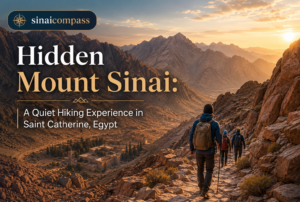
Hidden Mount Sinai is an alternative way to explore the Mount Sinai–Ras Safsafa mountain range near Saint Catherine in South Sinai. Instead of treating Mount Sinai as a simple climb to the famous summit, the experience takes hikers through quieter mountain basins, historic paths, secluded viewpoints and landscapes connected with centuries of monastic and Bedouin life.
For international travelers visiting Egypt who want something deeper than the standard overnight summit excursion, a Hidden Mount Sinai hike in Egypt offers a different perspective. The journey can combine nature, history, spirituality, photography and local knowledge, while allowing more time to experience the mountains themselves.
With SinaiCompass, the route can be planned around the traveler’s available time, hiking ability, interests and current mountain conditions rather than following one rigid itinerary.
Hidden Mount Sinai refers to the interconnected secluded basins and paths within the Mount Sinai–Ras Safsafa massif rather than to a separate mountain. SinaiCompass describes the experience as exploring hidden basins containing chapels, hermit cells, gardens and mountain viewpoints, with options ranging from a full day to an overnight experience.
What Is Hidden Mount Sinai?
Hidden Mount Sinai is a hiking experience through lesser-seen areas of the Mount Sinai and Ras Safsafa range around Saint Catherine. It reveals a much larger mountain landscape than visitors see when they simply follow the popular route directly to the summit of Jebel Musa.
The word “hidden” should not be understood as meaning secret, prohibited or unsafe. It describes secluded basins, terraces, old paths and viewpoints tucked between the granite peaks.
Within this landscape are places associated with early Christian monastic life, including small chapels, hermit areas, gardens, wells and historic mountain terraces. Some viewpoints also look down toward Saint Catherine’s Monastery and the surrounding valleys.
The result is a journey that feels very different from a conventional summit excursion. Instead of asking only, “How quickly can we reach the top?”, the experience encourages visitors to notice what lies between the valleys and peaks.
Hidden Mount Sinai vs the Standard Mount Sinai Hike
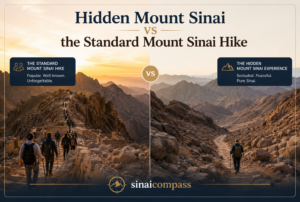
The main difference between Hidden Mount Sinai and a standard Mount Sinai hike is the focus of the journey.
A typical Mount Sinai excursion often concentrates on reaching the 2,285-meter summit of Jebel Musa, particularly for sunrise. Egypt’s official tourism portal identifies Mount Sinai as a 2,285-meter climb near Saint Catherine and highlights the well-known pre-dawn summit experience.
Hidden Mount Sinai expands the experience beyond that single objective.
| Experience | Standard Mount Sinai Hike | Hidden Mount Sinai Experience |
|---|---|---|
| Main focus | Reaching the summit | Exploring the wider mountain landscape |
| Typical atmosphere | Can be busy around popular sunrise periods | Generally quieter and slower paced |
| Landscape | Main summit trail | Basins, terraces, ridges and alternative viewpoints |
| Historical interest | Main sacred sites | Additional monastic and mountain heritage |
| Best suited to | Classic first-time summit visitors | Hikers, photographers, cultural travelers and repeat visitors |
| Duration | Usually focused on one ascent and descent | Can be planned as a full day or an overnight experience |
Neither experience is automatically better. They simply answer different travel intentions.
Where Is Hidden Mount Sinai?
Hidden Mount Sinai lies within the mountainous landscape surrounding Saint Catherine in South Sinai, Egypt, particularly around the Jebel Musa–Ras Safsafa massif.
Mount Sinai, locally known as Jebel Musa, and Ras Safsafa belong to the same granite mountain formation. Between the cliffs and peaks are secluded basins that historically provided space for monastic retreats, small gardens and places of shelter.
This region is especially important because it combines dramatic desert geology with religious and cultural heritage.
The wider Saint Catherine Area is recognized as a UNESCO World Heritage Site. UNESCO describes the area as sacred to Christianity, Islam and Judaism and highlights Saint Catherine’s Monastery, located at the foot of the mountain landscape.
What Do You See on a Hidden Mount Sinai Hike?
A Hidden Mount Sinai trek is less about checking off one attraction and more about moving through a connected mountain environment.
The exact route depends on access, weather, daylight, group ability and the plan agreed with the guide, but several types of landscapes define the experience.
Secluded Mountain Basins
Some of the most distinctive features are the natural basins hidden between steep granite walls.
These relatively sheltered terraces created places where soil and water could collect, making limited cultivation possible in an otherwise rugged environment.
They also provided isolation for monks and hermits seeking quiet locations away from populated areas.
Historic Chapels and Hermit Sites
The Mount Sinai–Ras Safsafa range contains evidence of a long monastic tradition.
Depending on the chosen route, travelers may see small chapels, ruins, hermit areas or traditional mountain gardens from permitted paths. SinaiCompass documents locations including Farsh Safsafa, Farsh Loza and Farsh al-Aramziya within the wider Hidden Mount Sinai route.
These places give the hike a historical dimension that is easily missed by travelers who only climb directly to the summit.
Views Toward Saint Catherine’s Monastery
One of the memorable elements of the route is seeing the Saint Catherine landscape from above.
Certain mountain viewpoints open across Wadi al-Deir toward Saint Catherine’s Monastery, providing a completely different perspective from visiting the monastery at ground level.
Mount Sinai and Ras Safsafa
Travelers also gain a better understanding of Mount Sinai as part of a larger massif rather than an isolated peak.
Ras Safsafa, Jebel Musa and the secluded basins between them create a complex landscape of granite ridges, gullies and natural terraces.
Why Choose a Hidden Mount Sinai Hike?
Choose Hidden Mount Sinai if you want a slower, more detailed and less conventional experience of the Saint Catherine mountains.
The route is especially appealing for travelers who value the journey as much as the final viewpoint.
- Explore areas beyond the standard summit itinerary.
- Spend more time surrounded by South Sinai’s mountain scenery.
- Learn about local Bedouin and monastic history.
- Find quieter places for rest and reflection.
- Enjoy landscape and travel photography in changing natural light.
- Combine hiking with cultural and spiritual interests.
- Experience Mount Sinai as part of a wider mountain ecosystem.
Is Hidden Mount Sinai Good for International Travelers Visiting Egypt?
Yes. Hidden Mount Sinai can fit particularly well into a wider Egypt itinerary for travelers who want to combine famous archaeological destinations with nature and outdoor experiences.
Egypt is often associated first with Cairo, Giza, Luxor and the Nile. South Sinai adds a very different landscape to that journey.
A traveler might visit ancient monuments in Cairo, spend several days on the Red Sea in Sharm El Sheikh or Dahab, and then move inland toward Saint Catherine for a mountain experience.
This makes the Hidden Mount Sinai hike relevant not only to specialist trekkers but also to tourists already planning a broader trip through Egypt.
Who Is the Hidden Mount Sinai Trek Best For?
The experience works particularly well for several types of visitors.
Nature Travelers
If granite mountains, desert valleys and quiet viewpoints are more interesting to you than crowded attractions, the wider Mount Sinai landscape deserves time.
Photographers
Daylight hiking and sunset-focused itineraries can provide changing shadows, warm rock colors and wide mountain panoramas.
History and Religious Heritage Travelers
The region’s significance goes far beyond the summit. UNESCO recognizes the Saint Catherine Area for its exceptional religious and cultural importance, while the surrounding mountains contain a much broader heritage landscape.
Couples and Private Groups
A private itinerary allows the walking pace and breaks to reflect the actual group rather than the schedule of a large excursion.
Travelers Who Have Already Climbed Mount Sinai
If you have previously completed the traditional summit route, Hidden Mount Sinai offers a reason to return and see a side of the range you may have completely missed.
How Difficult Is the Hidden Mount Sinai Hike?
Hidden Mount Sinai is generally a moderate mountain hike, but hikers should expect uneven terrain and several steep climbs.
SinaiCompass describes its Hidden Mount Sinai itinerary as a one- or two-day moderate experience with three steep climbs. The terrain is broken by flatter areas where hikers can rest, which may make the ascent feel different from a continuous direct climb.
That does not mean the hike is effortless.
You should be reasonably comfortable walking for several hours over rocky mountain ground. Fitness level, temperature, elevation, route choice and the length of the day can all affect how demanding the hike feels. see also.
Travelers with mobility concerns, recent injuries or medical conditions that may affect sustained hiking should assess the activity carefully before booking.
Can You Watch Sunset on Hidden Mount Sinai?
Yes. A Hidden Mount Sinai route can be planned around a sunset experience when conditions and timing permit.
One advantage of sunset hiking is that much of the ascent can take place during daylight. This allows travelers to see the landscape while walking instead of completing most of the climb in darkness.
SinaiCompass also offers private sunset-oriented Hidden Mount Sinai experiences where the route and stopping points can be adjusted according to the group and current conditions.
After sunset, however, mountain temperatures can fall quickly and part of the descent may take place in darkness. Appropriate layers and a light source are therefore important.
Can You Stay Overnight in the Mountains?
An overnight option can turn the hike into a slower two-day mountain experience.
Rather than returning immediately after a full day of walking, some itineraries can include a simple stay in a Bedouin garden in the Saint Catherine mountains.
SinaiCompass describes an overnight option that allows travelers to experience the garden environment before continuing with a lighter second day.
This can be particularly appealing to travelers interested in stargazing, silence and local mountain life rather than completing the area as a quick excursion.
What Should You Bring for Hidden Mount Sinai?
Mountain preparation in Sinai should focus on footwear, temperature changes, hydration and sun protection.
- Supportive walking shoes: rocky terrain requires reliable grip and stability.
- Layered clothing: conditions can change significantly between sunny daytime hiking and evening mountain temperatures.
- Sun protection: bring a hat, sunglasses and suitable sunscreen.
- Water: confirm with your guide how much you should carry and what is provided.
- Small backpack: keep essential items accessible without carrying unnecessary weight.
- Headlamp or flashlight: essential when the itinerary may continue after sunset.
- Personal medication: carry any medication you require during the day.
- Camera or phone: the route offers excellent landscape photography opportunities.
When Is the Best Time to Hike Hidden Mount Sinai?
There is no single perfect month for every traveler because weather in the high mountains can vary considerably between seasons and between daytime and nighttime.
The practical question is not simply “Which season is best?” but whether the conditions expected on your specific date are suitable for the chosen itinerary.
Before leaving, confirm the forecast, expected temperature, wind, sunset time and current route conditions with your guide.
Summer hikers should take exposure to sun and heat seriously, while colder periods require adequate layers, particularly around sunset and overnight stays.
Can You Visit Hidden Mount Sinai from Sharm El Sheikh or Dahab?
Yes, Saint Catherine can be incorporated into a South Sinai itinerary for travelers staying on the Red Sea coast, but transportation and hiking times should be coordinated in advance.
Visitors commonly combine Saint Catherine with destinations such as Sharm El Sheikh, Dahab and other parts of South Sinai.
For a full-day mountain hike, realistic transport planning matters. Trying to combine a long road transfer, substantial hike and return journey without enough time can make the experience unnecessarily rushed.
Send SinaiCompass your accommodation location before booking so the hiking plan can be considered together with transportation logistics.
Do You Need a Guide for Hidden Mount Sinai?
Local guidance is strongly recommended for a Hidden Mount Sinai hike.
This is not simply because of physical navigation. A knowledgeable local guide can help interpret paths, assess conditions, manage timing and explain cultural elements that would otherwise look like ordinary stones, terraces or ruins.
Guidance also matters because access conditions can change.
For example, SinaiCompass currently notes that Wadi al-Arbaeen and the Steps of Repentance are closed to access from town, while entry to monastery-owned properties may require prior authorization. These restrictions demonstrate why travelers should confirm the current route rather than relying on old blogs, maps or social-media itineraries.
Respecting Sacred Sites and Local Culture
Hidden Mount Sinai crosses a landscape that is not simply an outdoor recreation area.
For many people, the Saint Catherine region has deep religious meaning. It is also a lived Bedouin cultural landscape and home to an active monastic community.
Travelers should therefore approach chapels, gardens, monasteries, archaeological features and local communities respectfully.
- Do not enter closed religious or private properties.
- Follow instructions from your local guide.
- Do not remove stones, plants or historical objects.
- Keep noise low around religious and reflective areas.
- Ask before photographing people.
- Carry your rubbish out of the mountains.
- Avoid assuming that an old online route remains accessible today.
Why Choose SinaiCompass for a Hidden Mount Sinai Hike?
SinaiCompass is particularly relevant for travelers who want to experience the wider Saint Catherine mountain region instead of following only the most common tourist route.
The value of a locally planned experience is flexibility. A route can be discussed according to hiking experience, interests, available time and whether your priority is scenery, history, spiritual heritage, photography or a combination of these.
A local Bedouin guide also adds context that a GPS track cannot provide. The mountains contain generations of local knowledge involving paths, weather, water, gardens, place names and practical movement through the landscape.
SinaiCompass already works with multiple Hidden Mount Sinai formats, including full-day exploration, sunset-focused experiences and optional overnight stays, allowing travelers to discuss an itinerary suited to their trip rather than assuming one version works for everybody.
Common Mistakes to Avoid Before a Hidden Mount Sinai Trek
Assuming Hidden Mount Sinai Is Another Mountain
The name refers to the lesser-seen landscapes within the wider Mount Sinai–Ras Safsafa range, not a separate summit competing with Jebel Musa.
Planning from an Old Online Route
Access rules can change. Always confirm the current itinerary shortly before hiking.
Underestimating Mountain Temperatures
Warm conditions during part of the day do not guarantee warm conditions after sunset or at higher elevations.
Wearing Casual City Shoes
Rocky mountain paths require footwear with grip and support.
Trying to Fit Too Much into One Day
If you are traveling from another part of Sinai, account for road time as well as the hike itself.
Focusing Only on the Summit
The main reason to choose Hidden Mount Sinai is to experience the wider landscape. Rushing through the basins simply to reach the summit defeats much of the purpose.
Tips Before Booking Your Hidden Mount Sinai Hike
Before confirming the trip, give the tour provider enough information to recommend a realistic itinerary.
- Your travel date.
- Your accommodation location.
- Your number of travelers.
- Your approximate hiking experience.
- Any mobility concerns relevant to mountain walking.
- Whether you prefer a day hike or overnight option.
- Whether sunset is important to you.
- Your main interests: nature, photography, history, religious heritage or trekking.
This information is more useful than simply asking for “the best Mount Sinai tour,” because the best route depends on who is actually hiking it.
Is Hidden Mount Sinai Worth It?
Hidden Mount Sinai is worth considering for travelers who want to understand the mountain rather than simply reach its summit.
The famous Jebel Musa summit remains an extraordinary destination, but it represents only one part of the Saint Catherine landscape.
Beyond the busiest trail are granite basins, old gardens, historic religious sites, remote viewpoints and paths connecting a cultural landscape shaped over centuries.
For travelers coming to Egypt who already plan to visit the Red Sea or South Sinai, adding time in Saint Catherine can reveal a very different side of the country—quiet, mountainous and far removed from the major urban and archaeological tourism circuits.
Frequently Asked Questions About Hidden Mount Sinai
1. What is Hidden Mount Sinai?
Hidden Mount Sinai is a hiking experience through quieter basins, terraces and paths in the Mount Sinai–Ras Safsafa range near Saint Catherine rather than a separate mountain.
2. Is Hidden Mount Sinai the same as Jebel Musa?
Not exactly. Jebel Musa is the famous Mount Sinai summit, while Hidden Mount Sinai explores lesser-seen areas of the larger mountain massif around it.
3. How difficult is the Hidden Mount Sinai hike?
It is generally considered a moderate mountain hike with steep sections and rocky terrain. Reasonable hiking fitness is recommended.
4. How long does Hidden Mount Sinai take?
The experience can be designed as a substantial one-day hike, while an optional overnight stay can extend it into a two-day mountain journey.
5. Can I see sunset on Hidden Mount Sinai?
Yes. Sunset-focused itineraries can be arranged when weather, daylight, route access and group ability make the plan appropriate.
6. Is Hidden Mount Sinai suitable for beginners?
Some reasonably fit beginners may be comfortable with the route, but it remains a mountain hike with steep and uneven terrain. Discuss your experience with the guide beforehand.
7. Can I hike Hidden Mount Sinai alone?
A local guide is strongly recommended because route access, mountain conditions and local procedures can change, and the historical landscape is easier to understand with local knowledge.
8. Can I visit Hidden Mount Sinai while staying in Dahab?
Yes. Travelers staying in Dahab can plan a Saint Catherine hiking trip, but transport and the length of the mountain day should be arranged in advance.
9. Can I visit Hidden Mount Sinai from Sharm El Sheikh?
Yes. It can be included in a wider Sharm El Sheikh and South Sinai itinerary, with appropriate transportation and hiking-time planning.
10. How do I book a Hidden Mount Sinai hike?
Contact SinaiCompass with your date, accommodation location, group size, hiking experience and preferred type of trip so a suitable itinerary can be discussed based on current conditions.
Plan Your Hidden Mount Sinai Experience with SinaiCompass
Mount Sinai can be a summit, but it can also be an entire mountain journey.
If you want to move beyond the standard route and explore the quieter side of Saint Catherine, SinaiCompass can help you plan a Hidden Mount Sinai experience around your available time, hiking level and travel interests.
Share where you are staying in Egypt or South Sinai, your preferred date, the number of people in your group and whether you are interested in a full-day hike, sunset experience or overnight mountain journey. From there, SinaiCompass can help identify a realistic route based on current conditions.
Contact SinaiCompass and start planning your Hidden Mount Sinai hike in Egypt as part of a deeper journey through the mountains of Saint Catherine.