Wadi Feiran Christian Sites Private Day Tour
A Wadi Feiran Christian sites private day tour takes you beyond Sinai’s famous coastal resorts and into one of the peninsula’s most important early Christian landscapes. The oasis of ancient Pharan preserves the remains of churches, monastic sites and archaeological structures connected with centuries of Christian settlement. A private journey with Sinai Compass can focus on the Convent of Pharan, the ancient basilica area, Jebel Tahouna, hermit sites and the dramatic landscape beneath Jebel Serbal, with the exact route adapted to access conditions and your preferred walking level.
What is a Wadi Feiran Christian sites private day tour?
A Wadi Feiran Christian sites private day tour is a cultural and historical journey through the Feiran Oasis of South Sinai, concentrating on its early Christian heritage rather than treating the oasis as a brief roadside stop.
Ancient Pharan, the historical name associated with modern Feiran, became an important Christian centre in Sinai. The official website of Saint Catherine’s Monastery describes Pharan as the largest urban centre in the Sinai Peninsula during late Roman times and as the location of the Bishop of Sinai. Archaeological work in the area has uncovered parts of an early Christian city and at least seven churches dating between the fifth and seventh centuries, including a five-aisled basilica.
A private Wadi Feiran visit is most rewarding when the ruins, oasis, mountains and Christian traditions are explored as parts of one historical landscape rather than as separate sightseeing stops.
Why is Wadi Feiran important to Christian history?
Wadi Feiran matters because it preserves evidence of an organised Christian community in Sinai long before modern tourism developed around Mount Sinai and Saint Catherine. Pharan had an episcopal role, monastic communities and several churches spread across the oasis and surrounding mountains.
The area also belongs to the wider history of Christian pilgrimage through Sinai. Historical records preserved by the Library of Congress describe Wadi Feiran and neighbouring routes as corridors used by pilgrims, travellers and scholars travelling toward the sacred mountains of Sinai and Saint Catherine from Late Antiquity onward.
This makes Wadi Feiran particularly interesting for European visitors who already know the story of Saint Catherine’s Monastery but want to understand the wider Christian geography of South Sinai.
Christian sites to explore in Wadi Feiran
Convent of Pharan
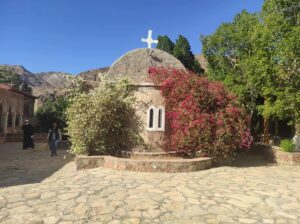
The Convent of Pharan is one of the main Christian landmarks within the oasis. It is sometimes referred to locally as Deir al-Banat and is connected administratively and spiritually with the wider monastic heritage of Sinai.
The official Saint Catherine’s Monastery account states that the convent is dedicated to the Prophet Moses. Its central church incorporates architectural fragments from earlier buildings, reflecting the long history of Christian occupation in the oasis.
Because this is a religious site rather than simply an archaeological attraction, visitors should treat access, photography and opening arrangements as subject to current local conditions.
The ancient basilica and Christian city of Pharan
One of the most significant parts of Wadi Feiran is the archaeological zone associated with ancient Pharan. Excavations have identified an extensive early Christian settlement containing several churches.
The discovery of seven churches, including a large five-aisled basilica, demonstrates that Pharan was more than an isolated hermitage. It was a substantial Christian centre with organised religious architecture between approximately the fifth and seventh centuries.
The surviving structures are archaeological remains rather than monumental reconstructed churches. A knowledgeable explanation therefore makes a substantial difference: walls, foundations and scattered architectural fragments become easier to understand when placed within the story of Byzantine Sinai.
Church traditions around Jebel Tahouna
Jebel Tahouna rises within the Wadi Feiran landscape and is associated with Christian archaeological remains. The Saint Catherine’s Monastery documentation identifies the ruins of an ancient church dedicated to the Prophet Moses on the mountain summit.
Sinai Compass also identifies Jebel Tahouna and hermit caves among the principal historical features around Wadi Feiran. Depending on the agreed itinerary, weather, access and walking ability, a private tour can focus on viewpoints and archaeological interpretation rather than requiring a demanding mountain ascent.
Churches of Saints Cosmas and Damian and the Dormition
The Christian heritage of Pharan is not limited to one church. The Convent of Pharan includes a more recent church dedicated to Saints Cosmas and Damian, connected with an inscription found at an earlier church of the same dedication. Another chapel is dedicated to the Dormition of the Theotokos and contains a burial place for the nuns.
Which interior areas can actually be visited should always be confirmed before the tour rather than assumed when planning the itinerary.
Wadi Feiran and the biblical tradition of Rephidim
Wadi Feiran is traditionally associated by many Christian travellers and historical traditions with Rephidim, one of the locations described in the Book of Exodus.
That association should be presented carefully. It is a longstanding religious and geographical tradition rather than an archaeological identification that can be stated as universally proven. Sinai Compass describes the destination as “Wadi Feiran – The Biblical Rephidim”, while historical documentation also records the traditional connection between the valley and the Exodus route.
For faith-oriented visitors, discussing both the biblical tradition and the archaeological evidence creates a more responsible experience than presenting tradition and historical proof as the same thing.
Jebel Serbal and the sacred landscape of Feiran
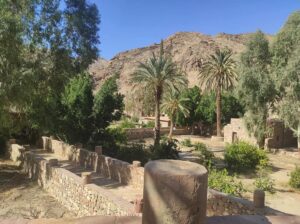
The enormous Jebel Serbal massif dominates the scenery above Wadi Feiran. It is important visually, historically and within traditions concerning the sacred geography of southern Sinai.
Some early Christian traditions associated Jebel Serbal with Mount Sinai. Today, the best-known identification of biblical Mount Sinai is centred on Jebel Musa near Saint Catherine, but Serbal remains an important part of the religious history of the region.
For visitors interested in landscape archaeology, this is one of the strengths of a Wadi Feiran day tour: churches and monastic ruins are seen within the mountains and oasis environment in which early Christian communities actually lived.
Is Wadi Feiran a UNESCO World Heritage Site?
No. Wadi Feiran is currently on Egypt’s UNESCO World Heritage Tentative List rather than being an inscribed World Heritage Site.
Egypt submitted Wadi Feiran as a cultural property to UNESCO’s Tentative List in 1994. The listing specifically refers to old monasteries, churches, tombs and other archaeological remains within the oasis area.
This distinction matters because “UNESCO-listed” is sometimes used loosely in travel content. A Tentative List property has been identified by a country for possible future nomination, but that does not make it a designated UNESCO World Heritage Site.
Example private Wadi Feiran day tour itinerary
A private itinerary should be confirmed individually because the starting point, road conditions, religious-site access and desired amount of walking can affect the programme.
- Private pickup: Meet at the agreed accommodation or departure point.
- Journey into South Sinai: Travel toward Wadi Feiran while observing the changing mountain and desert landscape.
- Arrival in Feiran Oasis: Begin with an introduction to ancient Pharan and the historical importance of the oasis.
- Convent of Pharan: Visit the convent area where access is available and learn about its connection with the Christian heritage of Sinai.
- Ancient basilica area: Explore archaeological remains connected with the early Christian city.
- Jebel Tahouna area: View or explore relevant historical features according to the agreed walking level.
- Oasis and landscape stops: Allow time for photography and interpretation of Wadi Feiran’s mountain setting.
- Return transfer: Travel back to the agreed destination.
Sinai Compass currently presents Wadi Feiran as a one-day road-trip option within its Christian-sites programme, although the final programme should always be confirmed directly before travel.
Wadi Feiran private tour from Sharm El Sheikh or Dahab
Travellers staying on the Red Sea coast can use a Wadi Feiran private tour to add a very different experience to a beach or diving holiday. Sharm El Sheikh and Dahab are common bases for visitors exploring South Sinai, while Saint Catherine provides another practical starting point for travellers already staying in the mountain region.
Sinai Compass states that it can arrange transport for individuals and larger parties across Sinai, including connections involving Sharm El Sheikh International Airport and other locations in the peninsula.
Rather than assuming a standard pickup time, travellers should provide their accommodation location when requesting the tour so the realistic transport plan can be confirmed.
Private tour versus a standard sightseeing excursion
| Feature | Private Wadi Feiran Tour | Typical Group Excursion |
|---|---|---|
| Pacing | Adapted to your group | Usually follows a fixed schedule |
| Historical focus | More time for Christian and archaeological interpretation | May cover several destinations quickly |
| Photography | Stops can be discussed in advance | Usually limited by group timing |
| Walking | Can be planned around ability | Usually follows one programme |
| Pickup | Agreed according to the itinerary | Often based on predetermined collection points |
Who will enjoy a Wadi Feiran Christian heritage tour?
The experience is particularly suitable for travellers who prefer historical context and cultural depth rather than simply collecting famous landmarks.
- Christian pilgrims exploring the wider sacred landscape of Sinai.
- Visitors interested in Byzantine and early Christian archaeology.
- Couples or small groups wanting a quieter private excursion.
- European travellers combining the Red Sea with cultural sightseeing.
- Photographers interested in desert, mountain and oasis landscapes.
- History enthusiasts visiting Saint Catherine and looking for related sites.
- Travellers interested in early monasticism.
What to prepare before visiting Wadi Feiran
Wadi Feiran is an inland desert and mountain environment, so preparation should be different from a normal day at a Red Sea resort.
- Wear comfortable closed walking shoes.
- Choose lightweight clothing appropriate for the weather.
- Carry sun protection, including a hat and sunscreen.
- Bring any essential personal medication.
- Dress respectfully when entering active religious areas.
- Ask in advance what water, food and refreshments are included.
- Confirm the expected amount of walking before booking.
- Check photography rules before photographing religious interiors or people.
Visitors travelling during hotter periods should discuss the timing of outdoor stops carefully. Weather and local conditions can also affect the most practical itinerary on the day.
Responsible travel at early Christian sites
Archaeological remains in Sinai can appear robust, but ancient walls, inscriptions and architectural fragments are vulnerable.
Do not remove stones or archaeological material, climb unnecessarily on ruins, carve names into surfaces or move objects to improve photographs. Where a route passes near active religious communities or local homes, visitors should respect privacy and follow local guidance. see also.
The purpose of a Christian heritage tour should be to understand the landscape while leaving it unchanged for future visitors.
Common mistakes when planning a Wadi Feiran tour
Presenting biblical tradition as archaeological certainty
The association between Wadi Feiran and Rephidim is important to Christian tradition, but responsible interpretation distinguishes religious tradition from conclusions that archaeology can prove independently.
Assuming every religious building will be open
Churches and convent spaces may have religious schedules or access restrictions. Ask which areas are expected to be accessible on your travel date.
Confusing Wadi Feiran with Saint Catherine’s Monastery
They belong to the same wider Christian landscape of South Sinai but are separate destinations. Wadi Feiran has its own history, archaeological remains and monastic heritage.
Planning too many stops
A private tour is more rewarding when enough time is allowed to understand the basilica ruins, convent and landscape instead of treating every location as a quick photograph.
Booking without discussing walking ability
Some archaeological areas are easier to approach than others. Tell the organiser whether you prefer a predominantly road-based cultural visit or would like to include more walking.
Why arrange your Wadi Feiran tour with Sinai Compass?
Sinai Compass is based in El Milgah, Saint Catherine, South Sinai and works with journeys across the peninsula. Its published activities include transport, hiking, trekking, Christian heritage experiences, camel journeys and 4×4 desert safaris.
For Wadi Feiran specifically, Sinai Compass identifies the Convent of Pharan, ancient basilica, Jebel Tahouna, hermit caves and Jebel Serbal among the main features of the oasis.
This makes it possible to discuss a journey according to what actually interests you: Christian history, archaeology, biblical geography, photography or a broader exploration of Sinai.
A private programme also allows practical questions to be discussed before departure, including the pickup location, expected walking level, transport arrangements and which historical sites are planned for the day.
Questions to ask before booking
- Where will the private pickup take place?
- Which Wadi Feiran Christian sites are planned for the visit?
- Is access to the Convent of Pharan expected on my date?
- How much walking is involved?
- Does the itinerary include Jebel Tahouna or only viewpoints?
- What transport is included?
- Are meals, drinks or water included?
- What clothing is recommended for religious sites?
- Can the itinerary focus more on archaeology or photography?
- What happens if access or weather conditions require a change?
Experience a different side of Christian Sinai
A Wadi Feiran Christian sites private day tour reveals a side of South Sinai that many visitors never encounter. Beyond the famous Mount Sinai journey lies an oasis where bishops, monks, hermits and Christian communities created churches and settlements more than a millennium ago.
The Convent of Pharan, ancient basilica remains, Jebel Tahouna and the backdrop of Jebel Serbal make Wadi Feiran valuable not simply as a biblical destination, but as a genuine archaeological landscape connected with the development of Christianity in Sinai.
If you would like to explore it privately, contact Sinai Compass with your travel date, starting location, group size and preferred walking level. The itinerary can then be discussed around the current access conditions and the parts of Wadi Feiran you most want to understand.
Frequently Asked Questions
1. Where is Wadi Feiran?
Wadi Feiran is in South Sinai, Egypt, within the mountainous interior of the Sinai Peninsula and on routes connecting the western side of Sinai with the Saint Catherine region.
2. What Christian sites can you see in Wadi Feiran?
Important sites include the Convent of Pharan, remains of the early Christian city and basilica, Jebel Tahouna and nearby hermit sites. Exact access should be confirmed before the visit.
3. Why was ancient Pharan important?
Pharan was a major late Roman settlement and the seat of the Bishop of Sinai. Archaeologists have identified several early Christian churches in the area.
4. Is Wadi Feiran the biblical Rephidim?
Wadi Feiran has traditionally been associated with Rephidim, but the connection should be understood as a historical and religious tradition rather than an undisputed archaeological identification.
5. Is Wadi Feiran a UNESCO World Heritage Site?
No. Wadi Feiran is on Egypt’s UNESCO World Heritage Tentative List, where it has been listed as a cultural property since 1994.
6. Is Wadi Feiran the same place as Saint Catherine’s Monastery?
No. They are separate destinations in South Sinai, although both belong to the wider history of Christian monasticism and pilgrimage in the peninsula.
7. Can I visit Wadi Feiran on a private day tour?
Yes. Sinai Compass presents Wadi Feiran as a one-day road-trip option, with the final route depending on the agreed starting point and itinerary.
8. Does a Wadi Feiran tour require difficult hiking?
Not necessarily. A largely road-based cultural visit can be arranged, while additional walking can be discussed for travellers who want to explore more of the surrounding sites.
9. Can European visitors combine Wadi Feiran with a Red Sea holiday?
Yes. It can provide an inland cultural experience for travellers staying in destinations such as Sharm El Sheikh or Dahab, subject to suitable transport arrangements.
10. How do I arrange a private tour with Sinai Compass?
Contact Sinai Compass with your preferred date, pickup location, group size and desired walking level. Ask for the exact itinerary, inclusions and current site-access arrangements before confirming.