Mount Sinai Sunset Hike With Private Bedouin Guide
A Mount Sinai sunset hike with a private Bedouin guide offers a different way to experience one of Egypt’s most significant mountain landscapes. Instead of beginning in the middle of the night for the traditional sunrise climb, a sunset hike allows you to ascend through the mountains of Saint Catherine during daylight, watch the evening colors spread across South Sinai, and descend after dark with local guidance.
For travelers who prefer a private pace, more time for photography, and direct contact with the landscape, SinaiCompass can arrange the experience around the group’s fitness, travel schedule, weather conditions, and local requirements. The objective is not simply to reach the summit quickly, but to experience Jebel Musa with enough time to appreciate its natural, spiritual, and cultural setting.
A Mount Sinai sunset hike combines mountain trekking, dramatic evening light, Bedouin local knowledge, and the historic landscape of Saint Catherine in one private experience.
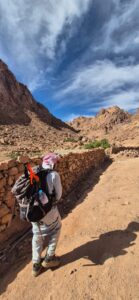
What Is a Mount Sinai Sunset Hike?
A Mount Sinai sunset hike is an afternoon ascent of Mount Sinai, also known as Jebel Musa or Mount Moses, planned so that hikers reach the summit or a suitable viewpoint before sunset. After watching the sun disappear behind the mountains, the group descends with appropriate lighting and guidance.
Mount Sinai rises to approximately 2,285 metres above sea level. Egypt’s official tourism website describes the mountain as a major hiking experience in Saint Catherine and notes that the traditional summit ascent is undertaken with Bedouin guides.
The sunset version changes the timing rather than the character of the mountain. The terrain remains rocky, the elevation remains significant, and the descent still requires attention. What changes is the atmosphere: much of the ascent takes place in daylight rather than during the night.
Why Choose Sunset Instead of Sunrise on Mount Sinai?
Sunset is especially attractive to travelers who want to see the mountain landscape while climbing. During a traditional sunrise itinerary, much of the ascent normally happens in darkness. A sunset departure lets you observe the valleys, granite peaks, changing shadows, and surrounding desert during the walk upward.
It also avoids the unusual sleeping schedule associated with many overnight sunrise trips. Rather than leaving a resort late at night and hiking before dawn, travelers can organize the experience around an afternoon start and return after sunset.
Sunset can be particularly appealing for:
- Photographers looking for warm evening light.
- Couples wanting a more private mountain experience.
- Families or private groups that prefer their own pace.
- Travelers uncomfortable with spending the entire ascent in darkness.
- Visitors staying in Saint Catherine who want more time in the mountains.
Sunrise still has its own appeal, particularly for visitors who want the classic pre-dawn Mount Sinai experience. Neither option is automatically better; the right choice depends on your schedule and preferred style of travel.
Mount Sinai Sunset Hike vs Sunrise Hike
| Feature | Sunset Hike | Sunrise Hike |
|---|---|---|
| Typical ascent | Mostly in daylight | Mostly before dawn |
| Main light | Golden evening light | Early morning light |
| Sleeping schedule | Usually easier to manage | Often requires overnight travel |
| Landscape visibility | Excellent during ascent | Limited until sunrise |
| Dark hiking | Mainly during descent | Mainly during ascent |
| Best suited for | Private groups, photographers, relaxed hikers | Travelers seeking the classic sunrise experience |
What Happens During a Private Mount Sinai Sunset Hike?
The exact itinerary depends on the date, daylight hours, weather, local instructions, and the physical ability of the group. A professionally planned hike should therefore be treated as a flexible mountain experience rather than a rigid schedule.
1. Arrival in the Saint Catherine Area
The hiking experience begins in the Saint Catherine region of South Sinai. Travelers may arrive from Saint Catherine itself or arrange transfers from destinations such as Sharm El Sheikh, Dahab, Nuweiba, or other parts of Egypt.
Because road conditions, checkpoints, pickup arrangements, and seasonal circumstances can affect transfer times, the exact departure schedule should be confirmed for the travel date rather than assumed from a generic online itinerary.
2. Meeting the Local Bedouin Guide
A local guide provides much more than directions. Bedouin knowledge of the mountains can help with pacing, route decisions, rest locations, weather awareness, and understanding how visitors should behave within the local landscape.
Egypt’s official tourism information specifically refers to hiking Mount Sinai with Bedouin guides, highlighting the established connection between local guiding traditions and mountain travel in Saint Catherine.
3. Beginning the Ascent in Daylight
The hike starts early enough to provide sufficient time to ascend without rushing. The guide should consider the group’s walking speed, rest requirements, sunset time, weather, and trail conditions.
The official tourism guidance describes the traditional summit trek as taking roughly three to four hours. Actual hiking time can vary considerably according to fitness, stops, route conditions, and individual pace.
4. Reaching the Sunset Viewpoint
The goal is to reach an appropriate viewing location while there is still enough daylight to settle in comfortably. Depending on local conditions and the agreed itinerary, this may be the summit or another suitable point within the permitted mountain route.
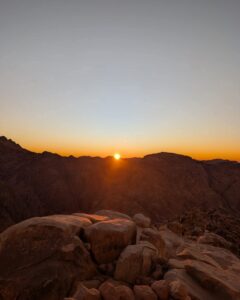
As the sun lowers, the granite mountains change from pale desert tones to deeper shades of gold, orange, pink, and violet. This gradual change in light is one of the main reasons photographers choose the evening hike.
5. Descending After Sunset
The adventure is not finished when the sun disappears. The descent is an important part of the experience and normally takes place partly or largely in darkness.
A headlamp, suitable footwear, warm clothing, and a controlled walking pace become especially important. Travelers should save enough energy for the descent rather than treating the summit as the end of the physical challenge.
How Difficult Is the Mount Sinai Sunset Hike?
Mount Sinai is a moderate-to-demanding mountain walk for many visitors rather than a casual sightseeing stroll. You do not generally need technical climbing skills on the standard hiking route, but the elevation, rocky ground, prolonged uphill walking, steps, and evening descent require reasonable mobility and fitness.
The difficulty varies according to personal conditioning. Someone who regularly walks hills may find the route manageable, while a traveler who rarely exercises may find the ascent tiring.
You should discuss any significant mobility, heart, respiratory, balance, or other health limitations with an appropriate medical professional before committing to a demanding mountain hike.
A private guide cannot remove the physical challenge, but a private arrangement makes it easier to adjust walking speed, rest breaks, and expectations around your group.
Why a Private Bedouin Guide Makes a Difference
A private Bedouin guide on Mount Sinai adds practical local knowledge and allows the hike to feel less like a fixed group excursion.
A Pace Adapted to Your Group
Large groups need to move according to a general schedule. A private group has more flexibility to slow down, rest, take photographs, or maintain a steady rhythm suited to its ability.
Local Mountain Knowledge
The Saint Catherine mountains are not simply an outdoor attraction. They are part of a living Bedouin cultural landscape. Local knowledge provides context about the terrain, traditional paths, mountain life, and the relationship between the community and the surrounding environment.
Better Decisions When Conditions Change
Mountain conditions are not identical every day. Wind, temperature, visibility, local instructions, and the physical condition of the group may require adjustments.
A responsible private hike allows the guide to modify the plan when necessary rather than forcing the group to follow an itinerary that no longer makes sense.
A More Personal Experience
Travelers often choose a private Mount Sinai tour because they want time to stop and experience the landscape rather than simply follow a crowd toward the summit.
The Cultural Importance of Saint Catherine and Mount Sinai
Mount Sinai belongs to one of Egypt’s most important cultural and spiritual landscapes. UNESCO lists the Saint Catherine Area as a World Heritage Site and describes the area around Mount Sinai as sacred to Christianity, Islam, and Judaism.
At the foot of the mountain stands Saint Catherine’s Monastery. The Egyptian Ministry of Tourism and Antiquities dates the monastery complex to the reign of Byzantine Emperor Justinian I in the sixth century.
This context changes the character of the hike. You are moving through a place that functions simultaneously as a mountain environment, a Bedouin homeland, a pilgrimage destination, and a landscape associated with centuries of religious history.
Visitors should therefore approach Mount Sinai with respect rather than treating it simply as a backdrop for photographs.
What Should You Bring for a Mount Sinai Sunset Hike?
Good preparation makes the hike considerably more comfortable. Even if the weather feels warm at the beginning, temperatures at elevation can feel much colder after sunset.
- Walking shoes: Wear footwear with reliable grip for rocky terrain.
- Warm layers: Carry an extra layer for the summit and descent.
- Headlamp: Essential for walking safely after sunset.
- Water: Carry sufficient drinking water for your expected hiking time.
- Light snacks: Useful for maintaining energy during the climb.
- Small backpack: Keep your hands free while walking.
- Sun protection: Sunglasses, sunscreen, and a hat may be useful during the afternoon ascent.
- Phone or camera: Sunset conditions can be excellent for landscape photography.
- Portable battery: Cold conditions and photography may reduce phone battery life.
- Personal medication: Bring anything you normally need rather than relying on availability on the mountain.
How to Prepare Before the Hike
You do not need to train like a mountaineer, but basic preparation can make a significant difference.
- Confirm the expected route and difficulty before booking.
- Tell the organizer about relevant physical limitations.
- Walk regularly in the weeks before your trip if you are normally inactive.
- Avoid wearing brand-new shoes for the first time on the mountain.
- Check the expected weather and clothing requirements shortly before departure.
- Eat a reasonable meal before hiking without making it excessively heavy.
- Carry water and a small energy snack.
- Begin at a sustainable pace rather than trying to climb quickly.
- Keep enough energy for the descent after sunset.
- Follow the guide if local or weather conditions require the route to change.
When Is a Mount Sinai Sunset Hike Most Comfortable?
Conditions in Saint Catherine differ substantially from Egypt’s coastal resorts and lowland cities. The elevation means temperatures can become surprisingly cool, especially once sunlight disappears.
Egypt’s official tourism portal notes that Saint Catherine’s high elevation can even bring winter snowfall.
During warmer periods, the afternoon sun can make the early part of the climb more demanding. During colder periods, the main challenge may be wind and low temperatures near the summit and during the descent. see also.
There is therefore no universal packing list for every month. Check the expected conditions for your actual hiking date and prepare for the mountain rather than relying on the temperature at your hotel in Sharm El Sheikh or Dahab.
Can You Combine the Sunset Hike With Saint Catherine’s Monastery?
Potentially, but monastery access should be treated as a separate scheduling question rather than automatically included with a sunset hike.
Saint Catherine’s Monastery is located at the foot of Mount Sinai and is one of the area’s most significant historic sites. Official published visiting hours are limited and differ by day, so travelers interested in entering the monastery should confirm current access arrangements before travel.
For many travelers, spending a night in Saint Catherine makes it easier to combine cultural sightseeing with hiking without forcing both experiences into an unrealistic schedule.
Responsible Hiking in the Saint Catherine Mountains
The landscape around Mount Sinai is both environmentally sensitive and culturally significant. UNESCO notes that the wider Saint Catherine area includes a protected natural landscape managed for conservation as well as Bedouin community interests.
Responsible visitors should:
- Carry rubbish away from the trail.
- Avoid removing rocks, plants, or natural objects.
- Keep noise low near spiritual and peaceful locations.
- Ask permission before photographing local residents.
- Respect private gardens and community spaces.
- Follow instructions concerning protected or restricted areas.
- Avoid leaving the agreed route simply to reach a photograph location.
Choosing locally guided hiking also helps connect tourism directly with people whose families and communities have long-standing knowledge of the Saint Catherine mountains.
Why Choose SinaiCompass for a Private Mount Sinai Sunset Hike?
SinaiCompass focuses on private planning rather than treating every traveler as part of the same fixed itinerary. That approach is especially useful on Mount Sinai, where fitness, weather, daylight, transfers, and personal travel style can influence how the day should be organized.
Private Rather Than Mass-Group Planning
The hike can be organized around your party, allowing more control over pace, breaks, photography time, and the general atmosphere.
Local Bedouin Guidance
Working with a local Bedouin guide adds practical mountain knowledge and provides meaningful cultural context that cannot be gained from simply following a GPS route.
Flexible Coordination
SinaiCompass can discuss transfer arrangements, the expected route, suitable departure timing, and optional additions according to availability and current conditions.
Clear Expectations Before the Hike
A good private-tour arrangement should make clear what is included, where the group meets, what equipment travelers should bring, how difficult the hike is expected to be, and what happens if conditions require a change.
The objective is not to promise that every sunset will be perfect. Weather cannot be controlled. The value of good planning is being prepared for the conditions that actually exist on the mountain.
Questions to Ask Before Booking Your Mount Sinai Hike
Before confirming a tour, ask for specific details rather than relying only on the words “private hike.”
- What route is currently planned?
- Is the summit the planned sunset viewpoint?
- What time should the hike begin on my travel date?
- Is a local Bedouin guide included?
- Where does pickup and drop-off take place?
- Is transportation private or shared?
- Are any local entrance or registration charges included?
- Should I bring my own headlamp?
- Are water or snacks included?
- What happens if wind or weather affects the route?
Common Mistakes to Avoid on a Mount Sinai Sunset Hike
Underestimating the Cold
South Sinai may be associated with sunshine and beaches, but high-altitude mountain conditions are different. Bring a warm layer even if the afternoon feels comfortable.
Focusing Only on Reaching the Top
The descent requires energy and concentration, especially after dark. Do not exhaust yourself trying to maintain an unnecessarily fast pace uphill.
Wearing Shoes With Poor Grip
Smooth-soled fashion shoes can make rocky terrain uncomfortable and less secure. Choose footwear suitable for walking.
Assuming Every Service Is Included
Transport, food, equipment, entrance costs, monastery access, and other services vary between itineraries. Ask for written confirmation before booking.
Ignoring the Guide to Chase a Photograph
Sunset light can tempt photographers toward exposed or unfamiliar locations. Stay within the route considered appropriate by your guide.
Booking an Unrealistic Same-Day Schedule
Do not place flights, long transfers, monastery visits, and a mountain hike into a schedule with no flexibility. Mountain travel works better when there is enough time for delays and changing conditions.
Is a Private Mount Sinai Sunset Hike Worth It?
For travelers who want to experience Mount Sinai as more than a quick sightseeing stop, a private sunset hike can be a rewarding choice. The daylight ascent reveals the scale of the Saint Catherine landscape, while sunset creates a completely different atmosphere above the surrounding valleys.
The strongest reason to choose a private format is not luxury. It is flexibility. You can move at a sensible pace, communicate directly with your guide, spend more time observing the landscape, and plan the day around your own travel schedule.
Combined with the cultural significance of Jebel Musa, the historic presence of Saint Catherine’s Monastery, and the knowledge of local Bedouin guides, the experience becomes one of Egypt’s most distinctive mountain journeys.
Plan Your Mount Sinai Sunset Hike With SinaiCompass
If you want to explore Mount Sinai without joining a standard overnight group, SinaiCompass can help you plan a private sunset hike based on your travel dates, group size, fitness level, pickup location, and preferred hiking style.
Before confirming, discuss the planned route, transportation, expected conditions, equipment, and any additional Saint Catherine experiences you would like to include. A clear conversation before departure is the simplest way to build an itinerary that matches both your expectations and the realities of the mountain.
Contact SinaiCompass to discuss your private Mount Sinai sunset hike and create a South Sinai experience built around your own pace rather than a fixed group schedule.
Frequently Asked Questions About Mount Sinai Sunset Hikes
Can you hike Mount Sinai at sunset?
Yes. A sunset hike can be arranged by starting during the afternoon and timing the ascent around daylight, weather, trail conditions, and the group’s walking pace.
How high is Mount Sinai?
Mount Sinai, or Jebel Musa, rises to approximately 2,285 metres above sea level.
How long does it take to climb Mount Sinai?
Egypt’s official tourism information describes the traditional summit trek as roughly three to four hours. Individual times vary according to fitness, stops, conditions, and route.
Do I need a Bedouin guide for Mount Sinai?
Guided hiking is the established visitor experience in Saint Catherine, and Egypt’s official tourism information specifically refers to Mount Sinai ascents with Bedouin guides.
Is the Mount Sinai sunset hike difficult?
It can be physically demanding because of prolonged uphill walking, rocky terrain, elevation, and the descent after dark. Reasonable fitness and mobility are recommended.
Do I need hiking boots?
Technical mountaineering boots are not generally required for the standard route, but sturdy walking or hiking shoes with good grip are strongly preferable.
Is it cold on Mount Sinai after sunset?
It can become considerably colder after sunset, especially at elevation and during winter. Carry warm layers even when conditions are mild at the start.
Can I visit Saint Catherine’s Monastery on the same day?
It may be possible, but monastery visiting times and the hike schedule must be coordinated carefully. Confirm current access before planning both activities together.
Can SinaiCompass arrange private transportation?
Transport arrangements can depend on your departure point and selected itinerary. Ask SinaiCompass to confirm pickup, drop-off, and whether transfers are private before booking.
Is sunset or sunrise better on Mount Sinai?
Sunset is ideal for travelers who prefer a daylight ascent and evening photography. Sunrise suits visitors who want the traditional overnight climb. The better choice depends on your priorities.