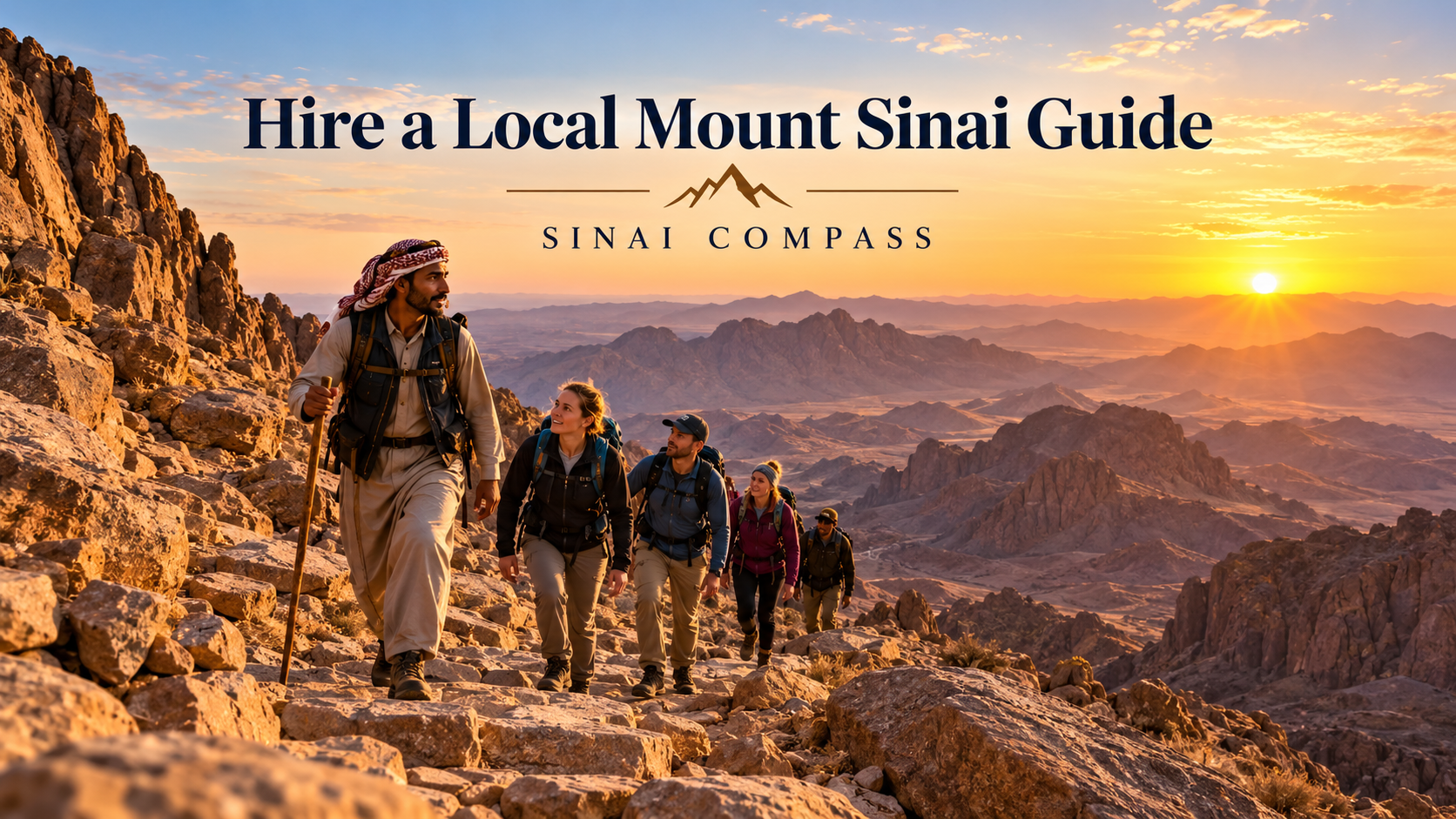
Hire a Local Mount Sinai Guide
Quick answer: A local Mount Sinai guide does more than show you the trail. The guide helps manage timing, navigation, local access, rest stops, mountain conditions, and cultural etiquette while adapting the hike to your fitness level and preferred experience.
hire a local Mount Sinai guide
Why Should You Hire a Local Mount Sinai Guide Instead of Hiking Alone?
A local Mount Sinai guide adds practical knowledge that cannot be replaced by a GPS track or an old travel blog. Routes, access conditions, weather, crowd levels, and local procedures can change, so current knowledge matters when planning a mountain hike.
Egypt’s official tourism platform specifically recommends checking with a tour operator, hotel, or licensed guide to confirm that a planned mountain or desert excursion is open to visitors. It also highlights expert guidance as an important part of exploring the trails around Saint Catherine.
For the standard Mount Sinai climb, Sinai Compass states that a Bedouin guide is required and can be arranged in the Saint Catherine monastery area. A guide becomes even more useful if you want to move beyond the conventional summit route into quieter sections of the Mount Sinai–Ras Safsafa range.
The value is not simply finding the path. An experienced guide knows how long different sections usually take, where the group can rest, how to adjust the pace, and which route makes sense for sunrise, sunset, photography, or a longer trekking day.
What Does a Local Mount Sinai Hiking Guide Actually Do?
A Mount Sinai hiking guide manages the mountain part of your journey. The exact service depends on your booking, but local guidance normally involves much more than walking in front of the group.
- Helping choose a route appropriate for your fitness and schedule.
- Managing ascent and descent timing.
- Guiding during darkness on sunrise hikes.
- Identifying practical places for breaks.
- Helping travelers understand current trail access.
- Providing local knowledge about the surrounding landscape.
- Explaining cultural, Bedouin, religious, and historical context.
- Adjusting the pace when conditions or group needs change.
- Coordinating with drivers, accommodation, or other local services when included.
Not every guide package includes transportation, meals, entrance fees, equipment, or accommodation. Ask for a clear written list of inclusions before booking.
Why Local Knowledge Matters When Hiking Mount Sinai in Saint Catherine
Mount Sinai is part of a much larger cultural and mountain landscape. The Saint Catherine Area is a UNESCO World Heritage Site recognized for its religious, historical, architectural, and cultural significance. UNESCO describes the region as sacred to Christianity, Islam, and Judaism and highlights the relationship between the monastery, Mount Sinai, archaeological remains, and the surrounding rugged landscape.
The mountains are also connected to local Bedouin communities whose knowledge has developed through generations of living and traveling through South Sinai. For visitors, this means a local guide can explain features that might otherwise appear to be ordinary paths, stone structures, gardens, or valleys.
A local guide is especially valuable when exploring less obvious routes. Sinai Compass notes that access to some areas can change and that certain monastery-owned properties may require authorization. This is one reason hikers should not assume that a route described online several years ago is still accessible today.
What Are the Main Routes a Mount Sinai Guide Can Help You Explore?
Mount Sinai, also known as Jebel Musa, rises to approximately 2,285 meters. Egypt’s official tourism portal identifies two principal summit approaches: the more gradual Camel Trail and the much steeper Steps of Repentance. Both eventually meet near the final section leading toward the summit.
Hire a Mount Sinai Guide for the Classic Camel Trail
The Camel Trail is the route most commonly associated with the standard summit experience. Its switchbacks create a more gradual ascent than the Steps of Repentance, although hikers still face a steeper final section before reaching the summit.
This route is widely used for pre-dawn sunrise hikes because it is relatively straightforward, but hiking in darkness still makes good pacing, lighting, footwear, and local guidance important.
Choose a Local Guide for a Mount Sinai Sunset Hike
Sunset provides a different experience. Most of the ascent takes place in daylight, allowing travelers to see the landscape instead of walking through darkness.
Sinai Compass recommends sunset to visitors who want a quieter atmosphere and more time to appreciate the mountain scenery. Crowd levels vary, so no specific level of solitude can be guaranteed.
Explore Hidden Mount Sinai With Local Guidance
Travelers with more time can explore beyond the direct summit path. Hidden Mount Sinai itineraries can include quieter mountain basins, historic trails, viewpoints, chapels, Bedouin gardens, and sections of the wider Mount Sinai–Ras Safsafa landscape.
These routes make local guidance particularly important because navigation and access can be less obvious than on the classic tourist path.Read also:
Local Mount Sinai Guide vs Group Tour vs Independent Planning
| Option | Best For | Main Advantage | Important Consideration |
|---|---|---|---|
| Private local guide | Couples, families, photographers, small groups | More control over pace and itinerary | Confirm transport and other inclusions separately |
| Organized group tour | Budget-conscious travelers | Simple fixed logistics | Less flexibility with pace and timing |
| Locally arranged custom hike | Travelers seeking deeper exploration | Route can be matched to interests and ability | Requires advance discussion about goals |
| Independent travel plus local guide | Flexible independent travelers | You control accommodation and transport | Several arrangements may need separate coordination |
A private guide does not necessarily mean every part of the journey is private. Ask whether the vehicle, hiking guide, transfers, and any additional experiences are exclusively for your party.
How Can U.S. Travelers Hire a Local Mount Sinai Guide?
American travelers should arrange the hike around the entire South Sinai itinerary rather than treating the guide as an isolated booking. Your starting location, hotel, arrival time, hiking ability, and preferred summit time all affect the plan.
- Choose your preferred experience. Decide between sunrise, sunset, a standard summit climb, or a longer mountain trek.
- Provide your starting point. Tell the operator whether you are traveling from Sharm El Sheikh, Dahab, Taba, Cairo, or Saint Catherine.
- Share your group size. This helps determine guide and transport arrangements.
- Explain your hiking experience. Be realistic about your fitness and comfort with stairs, rocky terrain, darkness, and several hours of walking.
- Ask what is included. Confirm guiding, transfers, fees, meals, water, accommodation, and equipment separately.
- Confirm the current route. Access should be checked shortly before the hike rather than assumed from older information.
- Get the meeting details. Make sure you know the pickup point, departure time, guide contact arrangements, and expected return.
What Should American Travelers Know Before Visiting Mount Sinai?
U.S. travelers should distinguish between different parts of the Sinai Peninsula when reading travel advice. The U.S. Department of State currently lists Egypt at Level 2, advising travelers to exercise increased caution. Its guidance specifically advises against travel to Northern and Middle Sinai, while separately telling travelers to use caution and check current information when traveling in Southern Sinai, including areas associated with Sharm El Sheikh, Dahab, Taba, Saint Catherine’s Monastery, and Mount Sinai.
Travel guidance can change. Check the latest U.S. State Department information close to departure, follow Egyptian access requirements, and maintain suitable travel insurance.
Travelers should also carry identification required for local travel and allow realistic time for transportation and checkpoints. Avoid planning a flight, long road transfer, monastery visit, and major mountain hike with an unnecessarily tight schedule.
What Should You Bring for a Guided Mount Sinai Hike?
The most important gear is simple: reliable footwear, appropriate layers, water, and lighting when hiking before sunrise or after sunset.
- Supportive hiking or walking shoes with good grip.
- A light backpack.
- Water appropriate for the length of your hike.
- Energy snacks unless food is confirmed in the tour.
- A headlamp for dark sections of the route.
- Warm layers for early morning and evening conditions.
- A wind-resistant outer layer when appropriate.
- Hat, sunglasses, and sunscreen for daylight hiking.
- A charged phone and optional power bank.
- Personal medication and basic travel essentials.
Saint Catherine sits at a much higher elevation than Egypt’s Red Sea resorts, and the mountain environment can feel considerably cooler. Pack for the mountain, not simply for the temperature at your coastal hotel.
How Difficult Is a Guided Mount Sinai Summit Hike?
The standard Mount Sinai summit hike is achievable for many travelers with reasonable fitness, but it is still a sustained mountain walk. The route includes uphill hiking on uneven surfaces and a steeper final approach.
Egypt’s official tourism website describes the pre-dawn Mount Sinai trek as approximately three to four hours to the summit, although actual timing varies according to fitness, route conditions, breaks, and group pace.
Tell your guide in advance if anyone in your group has limited hiking experience or difficulty with long climbs. A good itinerary should be planned around actual ability rather than assuming everyone moves at the same pace.
Anyone with a health condition that may be affected by strenuous exercise or altitude should seek appropriate medical advice before committing to the hike.
Why Choose Sinai Compass When You Need a Local Mount Sinai Guide?
Sinai Compass is based in El Milgah in the Saint Catherine area and organizes hiking, trekking, transportation, accommodation support, camel journeys, and other experiences across Sinai. Its published services include standard Mount Sinai climbs, sunset experiences, quieter Mount Sinai routes, multi-day hiking, camping, and transport connections involving Sharm El Sheikh, Taba, and Cairo.
The practical advantage of working with a locally based company is coordination. Instead of simply asking for “a Mount Sinai tour,” you can discuss where you are staying, when you arrive, what type of hiking you enjoy, and whether your priority is sunrise, sunset, spiritual heritage, photography, or a longer mountain experience.
Sinai Compass also describes itself as a local Bedouin-owned business working with guides, drivers, cameleers, camps, and accommodation providers in South Sinai.
This local network can be especially useful for international travelers who need to coordinate the mountain hike with transportation and accommodation rather than organizing each component after arriving in Saint Catherine.
What Should You Ask Before Hiring a Mount Sinai Guide?
A few specific questions can tell you far more than a generic tour description.
- Which route are we planning to use?
- Is the guide private to our group?
- How long should we expect to walk?
- What time will the hike begin and finish?
- Are transportation and hotel pickup included?
- Are water, meals, and entrance fees included?
- What equipment should we bring ourselves?
- Can the pace be adjusted for our group?
- Is the planned route currently open?
- What is the alternative plan if conditions change?
If your trip includes camping, also ask about sleeping equipment, meals, luggage storage, water, and what you personally need to carry.
What Common Mistakes Should You Avoid When Booking a Mount Sinai Guide?
Booking a Guide Without Confirming the Actual Route
Mount Sinai is not a single hiking experience. Sunrise, sunset, the standard Camel Trail, and wider mountain routes create very different days.
Choosing the Cheapest Offer Without Comparing Inclusions
A guide-only price cannot be fairly compared with an itinerary that includes private transportation, accommodation, meals, or longer hiking support.
Ignoring Your Pickup and Return Logistics
If you are staying in Sharm El Sheikh, Dahab, or Taba, the road journey is part of the experience. Confirm both the hike and transportation rather than assuming one automatically includes the other.
Underestimating Mountain Temperatures
Warm coastal weather does not guarantee warm conditions near the summit before dawn. Bring layers even when your Red Sea resort feels hot.
Relying on an Old Online Route Description
Access conditions can change. Confirm your route with a local guide or operator shortly before departure.
Assuming Sunrise Is Automatically the Best Choice
Sunrise is famous, but sunset can be a better fit for travelers who prefer hiking in daylight, sleeping normally the night before, or experiencing the mountains at a different pace.
Is Hiring a Local Mount Sinai Guide Worth It for a U.S. Traveler?
For most visitors who value local knowledge, straightforward logistics, cultural context, and route flexibility, hiring a local guide is a practical investment in the quality of the experience.
The mountain is already memorable because of its landscape and religious significance. A knowledgeable guide can add another layer by helping you understand where you are walking, how the routes connect, and how the mountain fits into the wider Saint Catherine landscape.
This matters particularly for travelers coming from the United States who may have limited time in South Sinai. Instead of spending part of a short trip solving transportation, timing, and access questions, you can arrive with the main arrangements already coordinated.

Is Hiring a Local Mount Sinai Guide Worth It for a U.S. Traveler
Frequently Asked Questions About Hiring a Local Mount Sinai Guide
1. Do I need a guide to hike Mount Sinai?
Sinai Compass states that a Bedouin guide is required for the standard Mount Sinai climb. Current local requirements should always be confirmed before your hike.
2. Where can I hire a Mount Sinai guide?
You can arrange a guide through a local Saint Catherine operator such as Sinai Compass or coordinate one as part of an organized Mount Sinai hiking package.
3. Can I hire a private Mount Sinai guide?
Yes. Private guiding is suitable for travelers who want more control over pace, timing, rest stops, and the overall itinerary.
4. How long does the Mount Sinai hike take?
The pre-dawn ascent is commonly described as taking about three to four hours, but timing varies with fitness, pace, route, and conditions.
5. Can a local guide take me to Mount Sinai for sunrise?
Yes. Sunrise is the classic Mount Sinai experience and normally involves beginning the hike during the night before reaching the summit around dawn.
6. Can I hire a guide for a Mount Sinai sunset hike?
Yes. Sunset hikes allow much of the ascent to take place in daylight and can provide an alternative to the traditional sunrise itinerary.
7. Does the guide fee include transportation?
Not necessarily. Confirm whether your booking includes only guiding or also transfers, entrance fees, meals, accommodation, and other services.
8. What should I wear for Mount Sinai?
Wear sturdy footwear and comfortable hiking clothing. Carry warm layers, particularly for sunrise, sunset, and cooler mountain conditions.
9. Can beginners hike Mount Sinai with a guide?
Many reasonably fit first-time hikers can complete the standard route, but you should discuss your fitness level and limitations with the guide before booking.
10. How can I arrange a Mount Sinai guide with Sinai Compass?
Contact Sinai Compass with your dates, group size, pickup location, fitness level, and whether you prefer sunrise, sunset, a private summit hike, or a longer Saint Catherine trek.
Hire a Local Mount Sinai Guide With Sinai Compass
Mount Sinai is not simply another tourist stop. It is part of a historic mountain landscape shaped by religious tradition, Bedouin culture, pilgrimage routes, monasteries, valleys, and centuries of human movement through the highlands of Saint Catherine.
If you are planning your visit from the United States, choose the experience first and build the logistics around it. Decide whether you want the classic sunrise, a quieter sunset, a private hike, or time to explore beyond the main summit route.
Contact Sinai Compass with your travel dates, starting location, group size, and hiking preferences. A locally planned itinerary can help you choose the appropriate route, coordinate your guide and transportation, and experience Mount Sinai at a pace that makes sense for your trip.