Mount Sinai Overnight Tour Booking: Complete Guide Before You Reserve
Sinai Compass helps travelers arrange Mount Sinai experiences around their starting point, group size, hiking ability, preferred schedule, and current local conditions. For American travelers adding South Sinai to an Egypt itinerary, confirming these details before payment is the simplest way to avoid misunderstandings about transportation, accommodation, guiding, and monastery access.
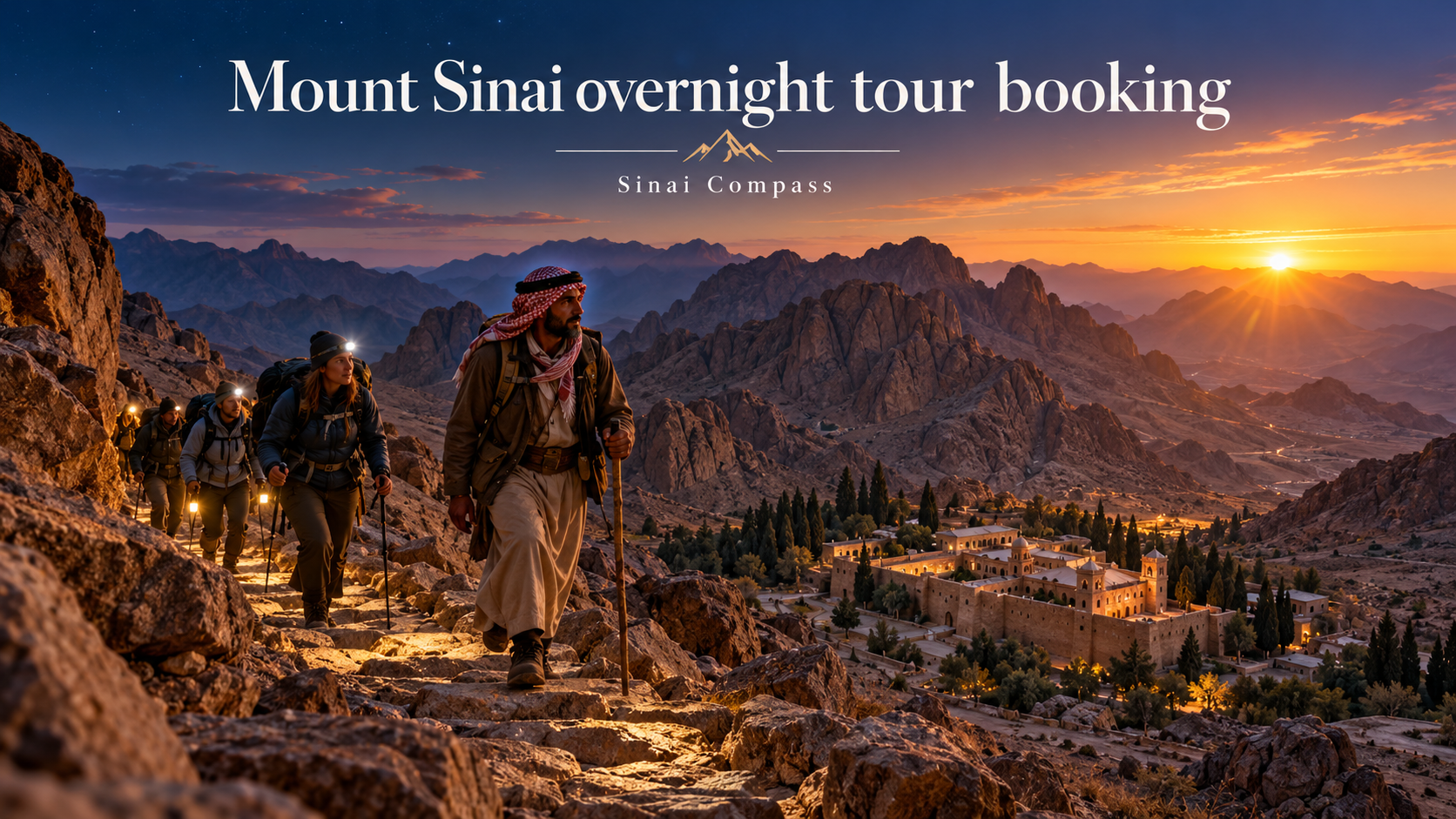
Mount Sinai overnight tour booking
What Does a Mount Sinai Overnight Tour Actually Include?
A standard Mount Sinai overnight tour often means traveling through the night rather than sleeping on the mountain. This distinction is important when comparing packages online.
For the classic sunrise experience from Sharm El Sheikh, travelers normally leave their accommodation during the evening, travel inland toward Saint Catherine, meet the local mountain guide, and begin hiking before dawn. After sunrise, the group descends and may visit Saint Catherine’s Monastery before returning to the coast. Sinai Compass describes its private sunrise experience from Sharm El Sheikh using this general overnight sequence.
Other overnight experiences can involve an actual overnight stay. For example, longer hiking programs in the Mount Sinai–Ras Safsafa landscape may include a simple night in a Bedouin garden before continuing the following day. Sinai Compass currently describes this as an option within its Hidden Mount Sinai experiences.
Two Different Types of Mount Sinai Overnight Tours
| Overnight Tour Type | What “Overnight” Means | Best For | Accommodation |
|---|---|---|---|
| Classic Sunrise Tour | Night transportation and pre-dawn hiking | First-time visitors and sunrise travelers | Usually no overnight sleeping stay |
| Overnight Mountain Experience | Longer hike with a night in the mountain area | Hikers, photographers, and slower travel | May include a simple Bedouin garden stay depending on itinerary |
Never assume that the word “overnight” includes a hotel, camp, or mountain accommodation. Ask for the exact sequence before paying.
How Does a Mount Sinai Overnight Sunrise Tour Work From Start to Finish?
The classic overnight itinerary is built backward from sunrise. Because hikers must reach the upper mountain before dawn, pickup time depends on the season, starting location, road journey, access procedures, and expected hiking pace.
A typical private overnight experience may follow this sequence:
- Evening hotel pickup: Meet your driver at the agreed accommodation in Sharm El Sheikh, Dahab, or another confirmed location.
- Night transfer to Saint Catherine: Travel inland through South Sinai toward the mountain region.
- Meet the local guide: Complete the required local arrangements before beginning the hike.
- Pre-dawn ascent: Follow the established route while it is still dark.
- Mountain rest stops: Stop when appropriate for water, warm drinks, or recovery.
- Final summit approach: Complete the steeper upper section before sunrise.
- Watch sunrise: Experience dawn over the surrounding Sinai mountains.
- Descend to Saint Catherine: Return toward the monastery area after sunrise.
- Visit Saint Catherine’s Monastery: Include the monastery when its opening schedule and your descent time allow.
- Return transfer: Travel back to your hotel or continue to your next destination.
Sinai Compass emphasizes that exact departure times should be confirmed for each date because sunrise times, hotel location, road conditions, procedures, and hiking pace can change the required schedule.Read Also
How Long Does the Mount Sinai Overnight Hike Usually Take?
Expect several hours of uphill walking before sunrise. Egypt’s official tourism portal describes the pre-dawn Mount Sinai trek as approximately three to four hours and identifies the summit elevation as about 2,285 meters above sea level.
The actual time varies by fitness, rest stops, trail conditions, group pace, and how crowded the route is. Reaching the summit quickly should not be the only objective. A well-planned tour allows enough time to climb steadily without forcing travelers to maintain an unrealistic pace.
The standard route does not normally require technical climbing skills, but it is still a genuine mountain hike. Much of the ascent takes place in darkness over rocky terrain, and the upper section becomes steeper.
Is a Private Mount Sinai Overnight Tour Better Than a Shared Group Tour?
A private overnight tour is usually better for flexibility, while a shared excursion is often better for travelers focused primarily on price.
A private arrangement can make transportation, pickup time, rest stops, and communication easier for couples, families, and small groups. It also gives travelers more opportunity to discuss their fitness level and preferred pace before the climb.
However, “private” does not mean that Mount Sinai itself will be empty. Sunrise is the mountain’s most popular period, and other visitors may be using the trail and summit at the same time. Sinai Compass specifically distinguishes private transportation and group arrangements from exclusive access to the mountain.
When a Private Overnight Mount Sinai Tour Makes Sense
- You want transportation arranged only for your party.
- You are traveling as a couple, family, or small group.
- You want more control over rest stops and pacing.
- You need monastery timing considered carefully.
- You prefer direct communication with your tour organizer.
- You want to combine Mount Sinai with additional Saint Catherine experiences.
Can You Visit Saint Catherine’s Monastery After an Overnight Mount Sinai Tour?
Yes, a monastery visit can often be combined with the sunrise hike, but access should be confirmed for your specific date.
Saint Catherine’s Monastery stands at the foot of the Mount Sinai landscape and is one of the major reasons travelers combine hiking with a cultural or religious visit. UNESCO recognizes the wider Saint Catherine Area as a World Heritage Site of exceptional importance to Christianity, Judaism, and Islam.
Egypt’s Ministry of Tourism and Antiquities currently lists public monastery visiting hours as 8:45 AM to 12:45 PM from Monday through Thursday and Saturday, 10:30 AM to 11:30 AM on Friday, with Sunday listed as closed. Religious observances or operational changes may affect access, so these hours should be reconfirmed before departure.
If visiting the monastery is essential to your trip, tell Sinai Compass before booking rather than treating the monastery as an automatic extra after the hike.
What Should American Travelers Know Before Booking a Mount Sinai Overnight Tour?
Travelers from the United States should review current official guidance before traveling into Sinai. The U.S. Department of State currently lists Egypt at Level 2: Exercise Increased Caution. Northern and Middle Sinai are identified as Level 4 areas, while the advisory separately tells travelers to be cautious and monitor conditions when traveling in Southern Sinai destinations including Sharm El Sheikh, Dahab, Taba, Saint Catherine’s Monastery, and Mount Sinai.
This geographic distinction matters. Mount Sinai and Saint Catherine are in Southern Sinai, but travelers should still check the latest advisory again shortly before departure because government guidance and regional conditions can change.
American visitors should also consider suitable medical and travel insurance, keep identification accessible, follow local instructions, and avoid photographing restricted security or military locations. The State Department recommends staying aware of current local information and carrying copies of important travel documents.
Why Overnight Planning Matters More for U.S. Visitors
For many Americans, Mount Sinai comes after a long international journey and may be combined with Cairo, Luxor, Sharm El Sheikh, or Dahab. An overnight hike can therefore create significant fatigue if scheduled immediately after a flight or before another demanding travel day.
Leave recovery time in your itinerary. Sunrise may be spectacular, but the experience includes nighttime driving, several hours of hiking, descent, and another road transfer afterward.
What Should You Wear and Pack for a Mount Sinai Night Hike?
Dress for a high mountain before dawn, not for a warm Red Sea resort. The temperature around the summit can feel substantially colder because of altitude, darkness, and wind.
Useful items include:
- Supportive hiking or walking shoes with reliable grip.
- Comfortable hiking trousers.
- A breathable base layer.
- A warm fleece or mid-layer.
- A wind-resistant outer layer.
- A warm hat during colder periods.
- A small backpack.
- Enough water for the planned route.
- An energy snack.
- A headlamp or torch unless supplied.
- A fully charged phone.
- A portable power bank.
- Personal medication.
Layering is particularly useful because you may feel cold while waiting near the summit but much warmer once you descend after sunrise. Sinai Compass recommends preparing specifically for changing mountain conditions rather than relying on coastal temperatures as a guide.
How to Complete Your Mount Sinai Overnight Tour Booking Step by Step
A clear booking process reduces uncertainty and makes it easier for the organizer to recommend a realistic itinerary.
- Select your date. Sunrise timing and monastery access depend on the date.
- Provide your pickup location. Give the exact hotel or accommodation rather than only the destination name.
- Confirm your group size. This affects transportation and guiding arrangements.
- Describe your hiking ability. Mention any mobility limitations or travelers who require a slower pace.
- Choose the overnight format. Decide between the classic night-transfer sunrise tour and an actual overnight mountain stay.
- Ask about the guide. Confirm how local mountain guiding is arranged.
- Request the complete inclusion list. Check transportation, guide services, food, access costs, accommodation, and optional camel services separately.
- Check the monastery plan. Confirm whether it is expected to be accessible on your date.
- Review cancellation conditions. Ask what happens if weather or local conditions affect the itinerary.
- Reconfirm before departure. Verify pickup time, weather, equipment, monastery status, and current travel information.
Should You Book a Standard Sunrise Tour or an Overnight Mountain Stay?
The right choice depends on what you want from Mount Sinai. Travelers primarily interested in the iconic sunrise usually prefer the standard overnight transfer and pre-dawn summit hike. Travelers looking for silence, stargazing, mountain culture, or deeper hiking may prefer a genuine overnight stay.
Sinai Compass describes Hidden Mount Sinai as an alternative to the direct summit experience, exploring quieter basins, historic paths, gardens, chapels, and viewpoints around the Mount Sinai–Ras Safsafa massif. Some itineraries can extend overnight with a simple stay in a Bedouin garden.
| Experience | Classic Sunrise Overnight Tour | Overnight Mountain Stay |
|---|---|---|
| Main Goal | Reach Mount Sinai for sunrise | Explore the wider mountain landscape |
| Night | Mostly spent traveling and hiking | Includes a planned sleeping stay |
| Atmosphere | Popular pilgrimage experience | Slower and often quieter |
| Best For | First-time visitors | Hikers and experiential travelers |
| Planning | Focused on sunrise timing | Focused on route, accommodation, and weather |
Why Choose Sinai Compass for Mount Sinai Overnight Tour Planning?
Sinai Compass focuses on South Sinai and the Saint Catherine mountain region, which is useful when an itinerary involves more than simply arranging a vehicle. Its published Mount Sinai services include private sunrise transportation, local hiking arrangements, sunset hikes, Hidden Mount Sinai routes, and longer mountain experiences.
The practical advantage is customization. Your pickup location, number of travelers, hiking experience, expected pace, monastery priorities, and interest in photography or pilgrimage can be discussed before the itinerary is finalized.
This approach also helps distinguish between travelers who genuinely want an overnight stay and those who want the classic sunrise excursion that happens overnight without accommodation.
The most important question before booking is not simply “How much is the overnight tour?” but “Exactly what happens between pickup and return?”
Common Mistakes to Avoid When Booking a Mount Sinai Overnight Tour
The most common mistake is assuming that “overnight tour” means accommodation is included. On many sunrise excursions, the night is spent traveling and hiking.
Another mistake is booking based only on price. A cheap listing may exclude private transport, food, guide arrangements, access costs, or monastery coordination.
Travelers also underestimate how cold the mountain can feel before sunrise, arrive in unsuitable shoes, or schedule another strenuous activity immediately after returning.
Do not assume that a private tour means a private summit. Other pilgrims and hikers may be present, particularly at sunrise.
Finally, avoid relying on old blog posts for monastery schedules or access information. Always reconfirm operational details for your actual travel date.
Final Advice Before Booking Your Mount Sinai Overnight Tour
A successful Mount Sinai overnight tour starts with clear expectations. Decide whether you want a classic sunrise excursion or a true overnight stay, understand the hiking demands, verify monastery access, and ask for every inclusion in writing.
For U.S. travelers, also review current government travel advice and build enough recovery time into your Egypt itinerary. The journey is more rewarding when you arrive prepared for the night transfer, mountain temperatures, sustained hiking, and return journey.
If you want an itinerary matched to your dates and travel style, contact Sinai Compass with your pickup location, group size, hiking experience, preferred date, and whether you want sunrise, Saint Catherine’s Monastery, or a longer overnight mountain experience. That information gives the team a practical basis for recommending the appropriate Mount Sinai plan.

Final Advice Before Booking Your Mount Sinai Overnight Tour
Frequently Asked Questions About Mount Sinai Overnight Tour Booking
What is a Mount Sinai overnight tour?
A classic overnight tour usually means traveling to Saint Catherine at night, hiking Mount Sinai before dawn, watching sunrise, descending, and returning later in the day.
Does a Mount Sinai overnight tour include accommodation?
Not always. Many sunrise tours involve nighttime transportation and hiking without a hotel stay. Confirm accommodation explicitly before booking.
How long does the Mount Sinai hike take?
Egypt’s official tourism portal describes the pre-dawn ascent as roughly three to four hours, although individual hiking times vary.
Is the Mount Sinai night hike difficult?
It is manageable for many reasonably fit travelers, but it involves sustained uphill walking, rocky terrain, darkness, and steeper sections near the summit.
Can I visit Saint Catherine’s Monastery after sunrise?
Often yes, when your descent and the monastery’s visitor schedule align. Confirm access for your specific travel date.
Can I book a private Mount Sinai overnight tour from Sharm El Sheikh?
Yes. Sinai Compass offers private Mount Sinai sunrise arrangements from Sharm El Sheikh with nighttime transportation and local hiking coordination.
What should I wear for Mount Sinai at night?
Wear supportive footwear and layered clothing, including a warm and wind-resistant layer. Temperatures can feel much colder than on the Red Sea coast.
Can I actually sleep overnight in the Saint Catherine mountains?
Some longer itineraries can include a simple overnight stay, such as a Bedouin garden experience. This is different from the standard sunrise excursion.
Is Mount Sinai suitable for American travelers?
Americans visit Southern Sinai, but they should check the latest U.S. State Department Egypt advisory and current local conditions before traveling.
How do I book an overnight Mount Sinai tour with Sinai Compass?
Provide your date, pickup location, group size, hiking ability, and preferred experience so transportation, guiding, and itinerary options can be discussed.