Mount Sinai Sunrise vs Sunset Tour
For travelers coming from the United States, Sinai Compass recommends looking beyond the famous summit photo and considering the entire day. Jet lag, hotel location, monastery opening hours, weather, transportation, and the return journey can make one option far more enjoyable than the other.

Mount Sinai sunrise vs sunset tour
Mount Sinai Sunrise vs Sunset Tour: Which One Should You Choose?
Sunrise is usually best for first-time visitors seeking the traditional Mount Sinai experience, while sunset is often better for travelers who prefer a peaceful daytime hike and fewer disruptions to their sleep.
| Comparison | Mount Sinai Sunrise Tour | Mount Sinai Sunset Tour |
|---|---|---|
| Typical ascent | Mostly at night | Mostly in daylight |
| Atmosphere | Iconic and communal | Quieter and more reflective |
| Crowds | Usually higher | Usually lower |
| Photography | Dawn and first light | Golden hour and warm mountain light |
| Sleep schedule | Overnight or very early departure | More conventional schedule |
| Trail visibility | Headlamp needed for ascent | Most ascent visible in daylight |
| Monastery planning | Often easier after descent | Usually needs separate timing |
| Best suited to | Classic experience, pilgrimage, first visit | Photography, quieter hiking, comfort |
Sinai Compass describes sunrise as the conventional overnight option and sunset as a much quieter daytime alternative. The company also notes that sunset hikers can usually begin several hours before sunset rather than climbing through the night.
What Happens on a Mount Sinai Sunrise Tour?
A Mount Sinai sunrise tour normally begins during the night. Travelers reach the Saint Catherine area, meet their mountain guide, and start climbing before dawn so they can reach the summit before the sun appears over the surrounding mountains.
The standard route commonly follows the Camel Path toward the upper mountain. Sinai Compass notes that sunrise climbers often begin around 2:00–3:00 a.m., although actual timing must depend on the season, sunrise time, group pace, weather, and local arrangements.
Why the Mount Sinai sunrise hike remains the classic choice
Sunrise has a strong emotional appeal. You climb in darkness, arrive near the summit before dawn, and watch the mountain landscape slowly emerge as the sky changes color. For many visitors, particularly those with a spiritual interest in Mount Sinai, that transition from darkness to first light is a central part of the experience.
The wider Saint Catherine Area is significant to Christianity, Islam, and Judaism. UNESCO identifies Mount Sinai, also known as Jebel Musa or Mount Horeb, and Saint Catherine’s Monastery as part of a cultural landscape of exceptional religious significance.
Who is most likely to enjoy sunrise?
- First-time visitors who want the best-known Mount Sinai experience.
- Travelers interested in the mountain’s religious and pilgrimage atmosphere.
- Visitors who want to combine the summit with Saint Catherine’s Monastery in the morning.
- People comfortable hiking in darkness with a headlamp.
- Travelers who do not mind losing part of a night’s sleep.
What Makes a Mount Sinai Sunset Tour Different?
A Mount Sinai sunset tour turns the schedule around. Instead of climbing before dawn, you ascend during the afternoon and reach the upper mountain as the light becomes warmer. That simple change can make the entire experience feel different.
Sinai Compass describes the sunset climb as a quieter alternative with much of the hike taking place during daylight. It recommends beginning the ascent around three hours before sunset as a general guideline, while recognizing that pace and conditions affect exact timing. Read also:
Why sunset can feel more relaxed than sunrise
You can see the landscape while you walk. The ridges, valleys, granite slopes, and changing shadows become part of the journey rather than something you discover mainly after sunrise on the descent.
Sunset also avoids the unusual sleep schedule associated with many sunrise excursions. This can matter considerably for American visitors who have recently completed a long-haul journey and are still adjusting to the time difference.
The quieter atmosphere is another advantage. Sinai Compass specifically presents sunset as the more peaceful alternative to the conventional sunrise hike.
Is Mount Sinai Better at Sunrise or Sunset for Photography?
Both are excellent, but sunset generally gives photographers more usable landscape time before reaching the summit.
Sunrise photography offers dramatic first light, silhouettes, and changing colors on the eastern horizon. The challenge is that most of your approach takes place in darkness, so photographic opportunities before reaching the upper mountain are limited.
With a Mount Sinai sunset hike, the landscape is visible during the ascent. As the sun lowers, side lighting can reveal rock textures and mountain layers more clearly. You also have more time to scout viewpoints before the strongest evening light arrives.
Choose sunrise photography if you want:
- First light over the Sinai mountains.
- Silhouettes and pre-dawn skies.
- The iconic sunrise-at-the-summit composition.
- A more energetic, communal summit atmosphere.
Choose sunset photography if you want:
- Golden-hour light across the mountain landscape.
- Daylight photographs throughout the ascent.
- More time to compose landscape shots.
- A greater chance of photographing the summit with fewer people nearby.
Which Mount Sinai Tour Is Less Crowded?
The sunset tour is generally less crowded than the sunrise tour.
Sunrise is the established choice for many organized excursions, particularly trips associated with Sharm El Sheikh, Dahab, and other South Sinai tourism centers. Travelers often arrive on similar schedules, which can create more activity along the final section of the trail and around the summit.
Sinai Compass notes that sunrise may be shared with many other visitors, while sunset can be much quieter. Actual crowd levels naturally vary by date, season, holidays, and local travel patterns.
If solitude is one of your main reasons for visiting Mount Sinai, sunset usually has the stronger advantage.
Is the Mount Sinai Sunrise or Sunset Hike Easier?
The physical climb is similar, but sunset may feel easier for travelers who prefer walking in daylight.
Night hiking adds a mental challenge. You see less of the terrain ahead, rely more heavily on artificial light, and may be climbing after an overnight transfer rather than after a normal night’s sleep.
During a sunset ascent, you can better judge rocky sections, anticipate the terrain, and pace yourself according to what you see. However, sunset hikers still need to plan for changing light. Depending on route, season, pace, and departure time, some of the descent may occur in darkness.
Sinai Compass also emphasizes that mountain difficulty depends on fitness, terrain, temperature, route choice, and the length of the hiking day.
What to pack for a Mount Sinai sunrise or sunset hike
- Supportive walking or hiking shoes with good grip.
- Layered clothing suitable for changing mountain temperatures.
- A warm outer layer for pre-dawn or post-sunset conditions.
- A reliable headlamp or flashlight.
- Water according to your guide’s advice and trip arrangements.
- Light snacks if they are not included in your tour.
- Sun protection for daylight sections.
- A small backpack rather than a heavy travel bag.
- Required identification and travel documents.
Can You Combine Mount Sinai With Saint Catherine’s Monastery?
Yes, but sunrise is normally easier to combine with a monastery visit because the monastery receives visitors during the morning.
The Egyptian Ministry of Tourism and Antiquities currently lists Saint Catherine’s Monastery visitor hours as 8:45 a.m. to 12:45 p.m. on most open days, with different Friday hours and Sunday listed as closed. These schedules can change, so travelers should verify the current timetable immediately before visiting.
A sunrise itinerary can work naturally because hikers watch dawn, descend, and then coordinate their arrival at the monastery with its morning opening period.
A sunset itinerary requires more planning. You may visit the monastery earlier in the day, stay overnight in Saint Catherine and visit it the following morning, or arrange a longer local itinerary.
Why Saint Catherine’s Monastery deserves separate time
The monastery is not simply an add-on to the mountain. Egypt’s Ministry of Tourism and Antiquities dates its construction to the reign of Byzantine Emperor Justinian I in the sixth century. Its complex includes the Church of the Transfiguration, the site associated with the Burning Bush, a historic mosque, and an important manuscript collection.
UNESCO describes it as the oldest Christian monastery continuously used for its original monastic function and recognizes the broader Saint Catherine Area as a World Heritage Site.
Which Mount Sinai Tour Works Better for Travelers From the United States?
For U.S. travelers, the best choice often depends on how Mount Sinai fits into a larger Egypt itinerary.
Visitors flying from cities such as New York, Los Angeles, Chicago, Dallas, Miami, or Washington, D.C. have already completed a long international journey before reaching Egypt. If Mount Sinai comes early in the trip, a sleepless sunrise excursion can be harder than expected because jet lag and overnight transportation may overlap.
Sunset may therefore be the more comfortable option for travelers who want to protect their sleep schedule. Sunrise makes more sense when the spiritual experience or a combined monastery visit is the priority.
Current U.S. travel guidance for Mount Sinai and South Sinai
American visitors should check the U.S. Department of State advisory immediately before travel. Current guidance distinguishes tourist areas in Southern Sinai, including Sharm El Sheikh, Dahab, Taba, Saint Catherine’s Monastery, and Mount Sinai, from areas of the Sinai Peninsula subject to stronger restrictions. The State Department advises travelers in Southern Sinai to remain cautious, monitor local information, and stay alert.
Travel advisories can change, so use the latest official guidance rather than an old blog post or cached itinerary when making safety and insurance decisions.
How to Choose Between a Mount Sinai Sunrise and Sunset Tour
Use the following process rather than choosing only because one option is more famous.
- Decide what matters most. Choose between spiritual atmosphere, photography, quiet hiking, or convenience.
- Consider your sleep tolerance. Sunrise usually involves an overnight schedule; sunset does not.
- Assess your confidence hiking in darkness. If you strongly prefer visible terrain, sunset may suit you better.
- Check your monastery plans. Morning opening hours make sunrise easier to combine with Saint Catherine’s Monastery.
- Think about crowd tolerance. Sunset is generally the quieter experience.
- Review seasonal conditions. Daylight hours, temperature, and weather affect both tours.
- Confirm transportation. Your starting point may be Saint Catherine, Dahab, Sharm El Sheikh, or another South Sinai location.
- Ask about guide arrangements. Sinai Compass states that a local Bedouin guide is required for the mountain and can be coordinated locally.
Why Choose Sinai Compass for a Mount Sinai Sunrise or Sunset Tour?
Sinai Compass focuses on experiences in and around Saint Catherine rather than treating Mount Sinai only as a quick stop from a resort. Its Mount Sinai information covers sunrise, sunset, and longer “Hidden Mount Sinai” hiking options, giving travelers alternatives based on time, interests, and preferred hiking style.
This local approach matters because a good mountain itinerary depends on more than the summit time. Pickup location, monastery opening hours, group pace, daylight, weather, local guide arrangements, and the return journey all affect the experience.
The better Mount Sinai tour is the one that matches your pace, schedule, interests, and current local conditions—not simply the one most travelers book.
For travelers who want a classic overnight climb, Sinai Compass can help organize a sunrise-oriented plan. Those who prioritize daylight hiking, photography, or a quieter mountain can discuss a sunset itinerary instead.
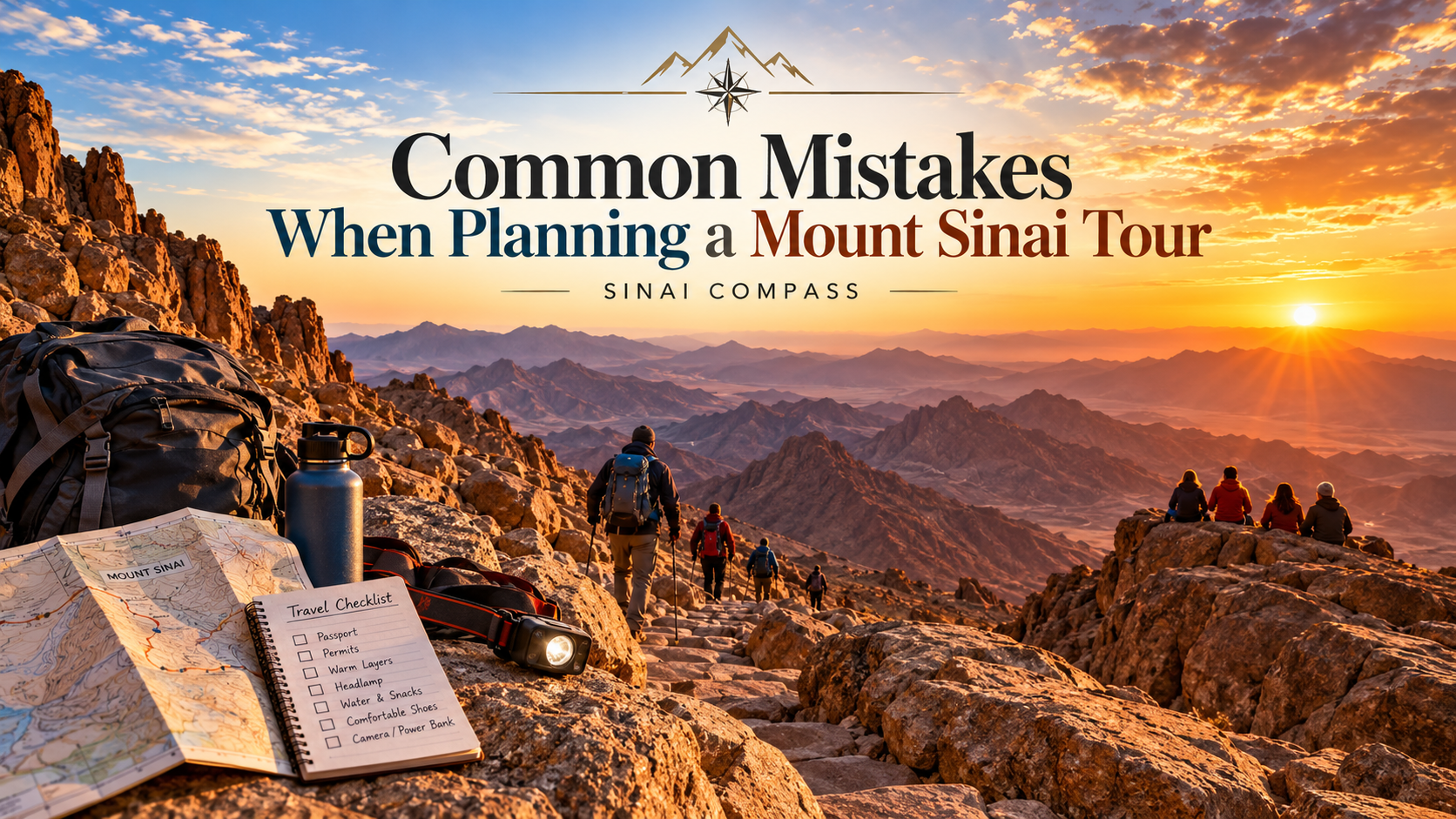
Common Mistakes When Planning a Mount Sinai Tour
Booking sunrise without considering the overnight schedule
A summit sunrise sounds simple until you combine a night transfer, several hours of walking, cold pre-dawn conditions, and the return journey. Look at the full itinerary rather than only the summit moment.
Assuming sunset means no hiking after dark
Always carry a headlamp. Your descent may continue as daylight fades, depending on timing and route conditions.
Using outdated monastery opening hours
Visitor schedules can change. Check the Egyptian Ministry of Tourism and Antiquities before finalizing your day
Dressing for the Red Sea coast instead of the mountains
Conditions around Saint Catherine can feel very different from Sharm El Sheikh or Dahab. Bring layers even when the coast is warm.
Choosing only by the lowest advertised price
Compare what is actually included: transportation, guide arrangements, waiting time, monastery planning, food, private versus shared service, and return transport.
Trying to fit too much into one day
Mount Sinai and Saint Catherine’s Monastery deserve time. A slower schedule can produce a better experience than rushing directly from a long overnight transfer into another full sightseeing day.
Common Mistakes When Planning a Mount Sinai Tour
Mount Sinai Sunrise vs Sunset Tour: Final Recommendation
Choose sunrise if you want Mount Sinai’s most iconic experience, value the pre-dawn spiritual atmosphere, and want to combine the mountain with Saint Catherine’s Monastery afterward.
Choose sunset if you prefer a quieter summit, daylight hiking, golden-hour photography, and a normal night’s sleep.
For many first-time visitors, sunrise remains the traditional choice. For photographers, repeat visitors, couples, private groups, and travelers who dislike overnight excursions, sunset can be the more rewarding option.
If your schedule allows it, consider spending time in Saint Catherine rather than treating the mountain as a rushed excursion. Mount Sinai is part of a larger UNESCO-listed cultural landscape whose significance extends far beyond a single sunrise or sunset.
Frequently Asked Questions About Mount Sinai Sunrise vs Sunset Tours
Is Mount Sinai better at sunrise or sunset?
Sunrise is better for the classic pilgrimage-style experience and combining the hike with Saint Catherine’s Monastery. Sunset is better for quieter hiking, daylight views, photography, and a more comfortable schedule.
Is Mount Sinai crowded at sunrise?
Sunrise is generally the busier period because many organized groups climb overnight to reach the summit before dawn. Sunset usually attracts fewer visitors.
Is a Mount Sinai sunset tour worth it?
Yes. Sunset offers a quieter mountain, daylight during most of the ascent, warm evening light, and an easier sleep schedule than the traditional sunrise excursion.
How early does a Mount Sinai sunrise hike start?
Sinai Compass notes that the conventional climb often begins around 2:00–3:00 a.m. Timing varies with season, sunrise, weather, pace, and local arrangements.
When should a Mount Sinai sunset hike begin?
A general guideline is around three hours before sunset, but the actual start should be set according to the season, route, hiking pace, and current conditions.
Is the Mount Sinai hike difficult?
The climb requires reasonable fitness and several hours of walking on mountain terrain. Difficulty varies according to route, pace, weather, footwear, fitness, and whether you are hiking in darkness.
Can I visit Saint Catherine’s Monastery after the sunrise hike?
Usually, the itinerary can be planned that way because the monastery receives visitors during morning hours. Always check the official schedule for your travel date.
Can I visit Saint Catherine’s Monastery after sunset?
Not immediately after the hike. Because the monastery has daytime visitor hours, sunset travelers normally visit it earlier that day or on another morning.
What should I wear for Mount Sinai?
Wear comfortable hiking shoes and layered clothing. Bring a warm outer layer, sun protection, and a headlamp for any walking before dawn or after sunset.
Is Mount Sinai suitable for U.S. travelers?
Americans do visit Mount Sinai, but they should review the latest U.S. State Department advisory, monitor conditions in Southern Sinai, and follow local transportation and security guidance.
Plan the Right Mount Sinai Experience With Sinai Compass
If you are still deciding between sunrise and sunset, the next step is to match the hike to your real travel schedule. Share your dates, starting location, group size, hiking experience, photography priorities, and whether you want to visit Saint Catherine’s Monastery with Sinai Compass. A locally planned itinerary can help you choose the Mount Sinai experience that fits your trip rather than forcing your trip around a standard tour.