Overnight Camel Safari from Dahab to Ein Khudra
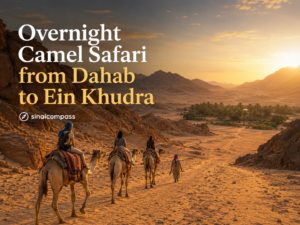
An overnight camel safari from Dahab to Ein Khudra is a two-day desert experience combining camel trekking, canyon walks, Bedouin hospitality and camping beneath the open Sinai sky. Travellers leave the Red Sea coast, enter the sandstone landscape of South Sinai and continue towards the palm-filled Ein Khudra Oasis, usually with a local guide and supporting transport.
What Is an Overnight Camel Safari to Ein Khudra?
An overnight camel safari to Ein Khudra is normally a two-day, one-night guided journey from Dahab into the South Sinai desert. It combines vehicle transfers, camel riding, walking through desert valleys or canyons, meals prepared during the trip and a night at a simple desert campsite.
The experience is different from a conventional jeep safari. Camels move slowly through the landscape, allowing travellers to notice the shape of the sandstone, the desert vegetation and the transition between open valleys, narrow passages and sheltered oases.
Camel safaris also include periods of walking. Some travellers prefer to ride for most of the accessible route, while others walk beside the camels and use them mainly to carry water, food and camping equipment. Sinai Compass describes walking and camel travel as complementary parts of a traditional desert safari rather than two completely separate activities.
Where Is Ein Khudra Oasis?
Ein Khudra, also written as Ein Hodra, Ain Khudra or Ain Hudra, is a desert oasis in South Sinai. Its name is commonly translated as “Green Spring”, referring to the water sources that support gardens and date palms within the surrounding dry landscape.
The oasis lies between steep sandstone formations and vertical cliffs. Several springs support its vegetation, creating a striking contrast with the pale mountains and sandy valleys around it. The area is often connected with routes through White Canyon, Wadi Ghazala and other desert landmarks.
Ein Khudra is accessible by vehicle from certain directions, but approaching it as part of a camel journey or canyon walk creates a more immersive experience. Instead of arriving only for photographs, travellers see how the oasis fits naturally into the wider desert environment.
Why Choose an Overnight Trip Instead of a Day Safari?
A day trip can introduce visitors to White Canyon and Ein Khudra, but an overnight trip provides more time for walking, resting and observing the desert after the daytime visitors leave. Sinai Compass specifically recommends spending at least one night in the desert for travellers who want to experience its atmosphere more fully.
| Feature | Day Safari | Overnight Camel Safari |
|---|---|---|
| Typical duration | One day | Two days and one night |
| Time in the desert | Limited by the return journey | Includes evening, night and early morning |
| Camel experience | Usually shorter | Can include several riding and walking stages |
| Desert atmosphere | Mainly experienced during daylight | Includes sunset, stargazing and sunrise |
| Meals | Usually lunch | May include lunch, dinner and breakfast |
| Best suited to | Travellers with limited time | Travellers seeking a deeper desert experience |
Experience the Desert After Sunset
Once the daylight fades, the desert becomes quieter and cooler. The evening is usually spent near the camp, where the guide prepares food and hot drinks over a fire when conditions allow. Without the normal noise of a town or resort, travellers can appreciate the scale and stillness of the landscape.
Wake Up Inside the Landscape
Sleeping in the desert means the second day begins without a transfer from Dahab. The group can have breakfast, pack the campsite and continue directly along the planned route. Early morning light also creates softer colours and more comfortable walking conditions during warmer periods.
Spend More Time with Local Guides
An overnight trip provides opportunities to learn about desert navigation, water sources, camel care and Bedouin customs. This cultural element should be approached respectfully: the safari is not a staged performance, but a journey supported by people whose families have long-standing knowledge of the area.
Typical Two-Day Itinerary from Dahab
The precise itinerary depends on weather, road access, group fitness, campsite selection and local conditions. The following programme is an example rather than a guaranteed route. Travellers should request a written itinerary for their actual booking.
Day One: Dahab, White Canyon and Ein Khudra
- Pickup from an agreed hotel, camp or meeting point in Dahab.
- Vehicle transfer towards the desert entry point, often in the direction of Wadi Ghazala.
- Meeting the Bedouin guide, camel handlers and camels.
- Camel riding or walking towards the selected canyon route.
- Exploring White Canyon where conditions and the itinerary permit.
- Continuing to Ein Khudra Oasis for rest and a prepared meal.
- Travelling towards the selected campsite or remaining near the oasis area.
- Watching sunset, eating dinner and spending the night in the desert.
White Canyon begins as a narrow opening in a sandy plateau and gradually widens as it approaches Ein Khudra. Sinai Compass notes that some easy climbing may be required in parts of the canyon, so the route should be discussed in advance by anyone with limited mobility or concerns about heights.
Day Two: Desert Valleys and Return to Dahab
- Early breakfast and preparation of the camels and equipment.
- A morning ride or walk through a nearby valley.
- Possible visits to locations such as Closed Canyon, Inscription Rock or surrounding sandstone formations, depending on the chosen route.
- Lunch or a rest stop in a shaded location.
- Return to the vehicle meeting point.
- Transfer back to Dahab during the afternoon or early evening.
Published two-day itineraries in the area commonly combine White Canyon, Ein Khudra, desert camping and additional locations such as Closed Canyon. However, routes differ between operators and may be changed for safety or practical reasons.
What Does Desert Camping Feel Like?
Desert camping in Sinai is intentionally simple. The experience is about the surroundings rather than hotel-style facilities. Depending on the arrangement, travellers may sleep on mattresses with blankets, inside a basic tent or beneath the open sky. see also.
There may be no conventional bathroom, shower, electricity or mobile signal at the campsite. Anyone booking the trip should ask exactly what sleeping equipment and sanitation arrangements are provided.
Temperatures can change considerably between the afternoon and the night. Even when Dahab feels warm, the desert may become cool after sunset, especially during winter. Layers are therefore more useful than relying on one heavy item of clothing.
Meals During the Safari
Meals are generally simple and suitable for preparation in remote conditions. They may include bread, rice, vegetables, salads, beans, chicken or other locally available ingredients. Tea is an important part of many rest stops and social moments.
Vegetarian, vegan, allergy-related or religious dietary requirements must be communicated before booking. Travellers should not assume that a remote camp can make last-minute substitutions after the journey has started.
Is the Camel Safari Difficult?
The safari is usually manageable for travellers with normal mobility and basic fitness, but it is not a passive sightseeing tour. Participants may need to walk over sand, uneven stones and narrow canyon sections. Getting onto and off a camel also requires balance and the ability to follow the handler’s instructions.
Camel riding can feel unfamiliar during the first few minutes. The camel rises and sits in stages, causing the rider to lean forwards and backwards. Holding the saddle securely and listening to the guide makes the movement easier.
Travellers should disclose back, hip, knee, balance or mobility problems before paying. Pregnant travellers and anyone recovering from surgery should obtain appropriate medical advice and discuss safer alternatives with the organiser.
Can Beginners Join?
Yes, previous camel-riding experience is normally unnecessary. Beginners should receive a clear explanation of how to sit, hold the saddle and behave when the camel stands, kneels or walks close to another animal.
Anyone who becomes uncomfortable can usually walk for suitable parts of the route, but this must be discussed with the guide because some sections may be too far, hot or difficult to complete entirely on foot.
What to Pack for an Overnight Camel Safari
Pack lightly, but bring enough protection for sun, wind, dust and cooler night temperatures. Ask whether your main luggage can remain securely at your Dahab accommodation.
- Comfortable closed walking shoes with reliable grip.
- Lightweight trousers suitable for riding and hiking.
- Breathable shirt and an additional warm layer.
- Sun hat, sunglasses and high-protection sunscreen.
- Personal water bottle or reusable flask.
- Small head torch with charged batteries.
- Toiletries, tissues and personal hygiene supplies.
- Necessary medication in the original packaging.
- Power bank for essential devices.
- Small bag for carrying personal waste.
- Passport copy and any required travel or insurance information.
- Camera protection against sand and dust.
Avoid bringing hard suitcases, unnecessary electronics, valuable jewellery or more clothing than you can comfortably carry. The organiser should confirm the size and type of bag that can be loaded onto the camels.
Best Time for a Camel Safari from Dahab
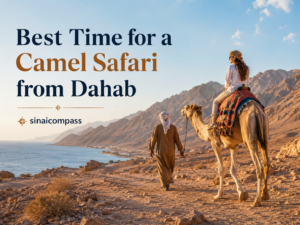
The most comfortable period is generally during the cooler part of the year, when daytime walking is easier and the risk of extreme heat is lower. Winter nights can nevertheless become cold, so warm layers remain important.
Spring and autumn can also provide suitable conditions, but wind, dust and changing temperatures are possible. Summer trips require careful planning, early activity periods and realistic decisions about heat exposure.
Weather should always be checked close to departure. A responsible guide may alter a canyon route or postpone part of the programme because of heat, strong wind, rain or flash-flood risk. Safety-related changes should not be treated as a failure to deliver the itinerary.
Advice for European Travellers Visiting South Sinai
Entry requirements, travel advice and insurance conditions vary between European countries. Before travelling, check the official guidance issued by your own government and confirm that your insurance covers Egypt, desert excursions, camel riding and overnight camping.
Keep digital and paper copies of important documents. Share the organiser’s contact details and expected return time with your accommodation or a trusted contact. Remote desert areas may have weak mobile coverage, so do not depend on constant internet access.
European electrical plugs, mobile roaming packages and payment methods may not work in every remote location. Carry a charged power bank and confirm whether the remaining safari payment must be made in Egyptian pounds, euros or another agreed currency.
Visitors should also respect local customs. Wear practical, relatively modest clothing, ask permission before photographing people and avoid entering private gardens or shelters without an invitation.
Responsible Travel in the Sinai Desert
The desert can appear empty, but it contains fragile plants, water sources, archaeological traces and areas used by local families. Responsible travellers avoid leaving food packaging, wet wipes, cigarette ends or plastic bottles behind.
- Carry out all non-biodegradable waste.
- Do not remove stones, plants or archaeological material.
- Use existing tracks and campsites where possible.
- Do not contaminate springs with soap or chemicals.
- Keep noise low around settlements and animals.
- Follow the guide’s instructions concerning fires.
- Support locally guided services and fairly paid workers.
Responsible tourism protects the landscape while ensuring that local guides, camel handlers, drivers and families receive meaningful benefits from the journey.
Why Organise the Safari with Sinai Compass?
Sinai Compass focuses on travel within the Sinai Peninsula, including camel safaris, walking routes, desert excursions, transport and locally coordinated experiences. The company presents camel travel and walking as traditional ways to explore areas that cannot be understood properly during a rushed vehicle stop.
Transport can be arranged between Dahab, Sharm El Sheikh, Nuweiba, Taba and Saint Catherine, as well as for desert excursions and remote areas. Sinai Compass states that it works with licensed vehicles and experienced local drivers, although travellers should still confirm the exact vehicle and service for their booking.
A further advantage is the possibility of adapting the trip. A private couple, family, group of friends or photography-focused traveller may require different riding times, walking distances and sleeping arrangements.
Before confirming, ask Sinai Compass to provide the planned route, pickup details, approximate activity level, sleeping setup, meal arrangements, guide language, cancellation terms and complete price.
Questions to Ask Before Booking
- Is the safari private or shared with other travellers?
- Which locations are planned for each day?
- How long will we ride and walk?
- What sleeping equipment is provided?
- Are meals, drinking water and hot drinks included?
- Which toilet arrangements are available?
- Is hotel pickup and return transport included?
- Can dietary or mobility requirements be accommodated?
- What happens if weather conditions change the route?
- What are the payment, cancellation and refund terms?
Request written confirmation instead of relying on a general description or an old online itinerary. Desert routes, prices and inclusions can change according to season, group size and local conditions.
Common Mistakes to Avoid
Choosing the Trip Only by Price
A lower price may reflect fewer meals, shorter camel stages, basic sleeping equipment or transport that is not included. Compare complete inclusions rather than the headline amount.
Wearing Open Sandals
Sandals offer little protection against stones, rough ground and hot surfaces. Closed walking shoes are a safer choice for canyon and valley sections.
Bringing Too Much Luggage
Large bags are difficult to transport by camel and can slow the group. Bring only essential overnight items in the type of bag approved by the organiser.
Ignoring Night Temperatures
Travellers often prepare for daytime heat but forget that the desert may become cold after sunset. Always pack at least one warm layer.
Expecting a Luxury Camp
An authentic overnight safari normally provides simple facilities. Ask for photographs or a precise description when a private tent, raised bed or particular level of comfort is essential.
Failing to Mention Health or Dietary Needs
Remote locations limit the ability to solve unexpected problems. Inform the organiser about allergies, medication, mobility concerns and dietary requirements before departure.
Final Thoughts
An overnight camel safari from Dahab to Ein Khudra offers a balanced introduction to the interior of South Sinai. It is long enough to include camel travel, walking, an oasis visit, sunset, desert camping and a peaceful morning, while remaining practical for travellers with a limited holiday schedule.
The most rewarding experience comes from choosing a realistic route, travelling with knowledgeable local guides and accepting that desert conditions may require flexibility. Clear communication about fitness, comfort, food and equipment is just as important as selecting the attractions.
Contact Sinai Compass with your travel date, number of participants, Dahab pickup location and preferred activity level. The team can help shape an overnight safari that combines Ein Khudra, camel trekking and Bedouin-style desert camping in a way that suits your journey through Sinai.
Frequently Asked Questions
How long is the overnight camel safari from Dahab?
The experience normally lasts two days and one night, although departure and return times depend on the selected route and conditions.
Do I need previous camel-riding experience?
No. Most first-time riders can participate after receiving basic instructions from the camel handler.
Will I ride the camel for the entire journey?
Usually not. Most safaris combine camel riding with walking through canyons, valleys and uneven sections.
Where do travellers sleep?
Travellers usually sleep at a simple desert campsite using mattresses, blankets and either a basic tent or an open-sky setup.
Are meals included?
Meals are often included, but the exact number of meals, drinks and bottled water must be confirmed before booking.
Is Ein Khudra suitable for children?
Some children may enjoy the trip, but suitability depends on age, stamina, weather, riding ability and the specific itinerary.
Are toilets available at the campsite?
Facilities may be very basic or unavailable. Ask the organiser to explain the sanitation arrangements before confirming.
What should I wear?
Wear closed walking shoes, comfortable trousers, sun protection and layered clothing for cooler evening temperatures.
Can dietary requirements be accommodated?
Many requirements can be considered when communicated in advance, but remote camps may have limited alternatives.
Can the itinerary change?
Yes. Guides may modify the route because of weather, canyon conditions, road access, group ability or other safety considerations.