Serabit El Khadem private desert safari
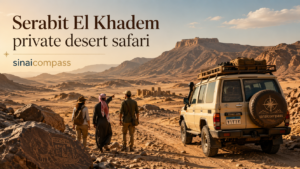
A Serabit El Khadem private desert safari is an expedition into one of the most remote and historically significant landscapes in South Sinai. The experience combines off-road desert travel, mountain hiking, ancient turquoise mines, Bedouin culture and the remains of the Temple of Hathor on a high desert plateau.
What is a Serabit El Khadem private desert safari?
A Serabit El Khadem private desert safari is a customised journey to the archaeological and desert region of Serabit El Khadem in southwest Sinai. It normally involves travelling through remote valleys and desert tracks before continuing on foot towards the mountain plateau where the ancient temple complex is located.
The central attraction is the Temple of Hathor, which was connected to ancient Egyptian expeditions searching for turquoise and copper. The temple stands near former mining areas and contains remains of sanctuaries, chambers, inscriptions and stone stelae associated with different periods of Egyptian history.
The temple appears to have been established during the Middle Kingdom under Senusret I and expanded during later periods. Hathor was known here as the “Lady of Turquoise,” reflecting the close relationship between the sanctuary and the mining expeditions working in Sinai.
Serabit El Khadem is not simply an archaeological stop. The journey through the surrounding desert is an essential part of understanding why the ancient site was built in such an isolated location.
Why is Serabit El Khadem historically important?
Serabit El Khadem played an important role in Egypt’s ancient mining activities. Pharaohs sent organised expeditions into Sinai to obtain turquoise and other mineral resources. Workers, officials, soldiers and religious representatives travelled together, leaving inscriptions and monuments that documented parts of their journeys.
The Temple of Hathor
The Temple of Hathor was both a religious sanctuary and a symbolic centre for the mining expeditions. Participants made offerings to Hathor in the hope of finding valuable turquoise and returning safely to the Nile Valley.
The surviving archaeological remains include processional routes, sacred areas, caves, stone blocks and numerous stelae. Although the site is less visually complete than the major temples of Luxor or Aswan, its remote position and connection to desert mining make it highly distinctive.
The ancient turquoise mines
Turquoise was valued in ancient Egypt for jewellery, royal ornaments, amulets and ceremonial objects. Serabit El Khadem became one of the principal areas from which the mineral was obtained.
During a guided visit, travellers may learn how miners worked in the surrounding mountains, how expeditions were supplied and why religious rituals were closely connected to the dangers of desert travel and mining.
Proto-Sinaitic inscriptions
Serabit El Khadem is also associated with inscriptions that are important to the study of early alphabetic writing. These inscriptions are often described as Proto-Sinaitic and are studied for the way they adapted elements of Egyptian hieroglyphic signs into a simpler writing system.
Interpretations of individual inscriptions continue to be discussed by specialists, so visitors should be cautious about dramatic claims. Their importance lies in what they reveal about contact between Egyptian and Semitic-speaking communities working in the Sinai mining region.
UNESCO Tentative List status
The Temple of Serabit Khadem has been included on Egypt’s UNESCO World Heritage Tentative List as a cultural site since 1994. Tentative status does not mean that the temple is already a designated World Heritage Site, but it recognises its potential heritage significance.
What can you experience during the safari?
The precise programme depends on the starting point, weather, access arrangements, group ability and number of days available. A well-planned private safari may combine several elements rather than focusing only on the archaeological ruins.
| Safari element | What to expect | Why it matters |
|---|---|---|
| Private transport | Door-to-door transfers and off-road travel arranged for your group | Provides flexibility and avoids the timetable of a shared excursion |
| Desert driving | Travel through valleys, open plains and remote tracks | Reveals the scale and isolation of southwest Sinai |
| Guided hiking | A mountain walk towards the archaeological plateau | Allows access to the temple while explaining the surrounding landscape |
| Historical interpretation | Information about Hathor, mining expeditions and ancient inscriptions | Turns scattered ruins into a meaningful historical experience |
| Bedouin hospitality | Simple meals, tea or camping arrangements where included | Introduces visitors to contemporary desert traditions |
| Private pacing | Stops and walking speed adapted to the group | Useful for photographers, couples, families and mature travellers |
Travelling through the remote Sinai landscape
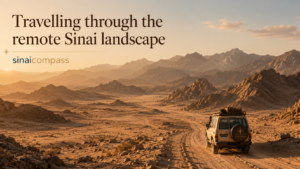
The approach to Serabit El Khadem passes through a landscape of broad valleys, sandstone formations, rocky mountains and open desert. The route is very different from the coastal resorts of Dahab and Sharm El Sheikh.
The journey gives travellers time to observe the geography that shaped ancient movement across Sinai. Water availability, mountain passes and mineral deposits influenced where people travelled and where temporary settlements developed.
Climbing to the archaeological plateau
The temple is positioned on a mountain plateau, so visiting it requires walking uphill. The exact route and difficulty can vary. Some paths are gradual, while alternative approaches can be steeper and more demanding.
Serabit El Khadem is outside the usual tourist circuit. One documented approach reaches the area from Abu Zenima before continuing inland towards the mountain, with the final visit involving a substantial walk to the plateau. see also.
Travellers should give the organiser accurate information about their fitness, previous hiking experience and any mobility limitations. A private itinerary makes it easier to plan suitable rest stops and avoid unnecessary pressure.
Watching the desert light
The colours of the region change throughout the day. Morning light reveals details in the rock formations, while late-afternoon light creates warmer tones across the valleys and mountains.
Travellers interested in photography should request sufficient time rather than treating the site as a quick stop. A private desert safari is particularly useful when photography, landscape observation or quiet exploration is a priority.
Example private Serabit El Khadem safari itinerary
A private itinerary should be confirmed individually rather than assumed to follow a fixed schedule. The following example shows how an expedition may be organised.
- Private pickup: Collection from the agreed hotel, camp, airport or meeting point.
- Transfer towards western Sinai: Travel by suitable vehicle towards the access route for Serabit El Khadem.
- Desert entrance: Continue through inland tracks with stops for views, tea or photography.
- Arrival near the mountain: Meet the local guide and prepare water, sun protection and walking equipment.
- Guided ascent: Walk towards the archaeological plateau at a pace suitable for the group.
- Temple exploration: Visit the ruins, stelae, sacred areas and viewpoints while learning about the mining expeditions.
- Return to the base: Descend carefully and rest before continuing the journey.
- Camp or onward transfer: Depending on the agreed programme, spend the night in the desert or return to the chosen destination.
Longer itineraries may include additional valleys, geological formations, Bedouin settlements, desert camping or other locations in western and central Sinai. Every stop should be agreed before booking because access conditions and travelling times can change.
Why choose a private safari instead of a group tour?
A private safari offers greater control over the experience. This is especially important at Serabit El Khadem because the destination is remote and the visit involves more logistical planning than a conventional resort excursion.
- The departure time can be adapted to your accommodation and travel plans.
- The hiking pace can reflect the fitness of your group.
- More time can be allocated to archaeology or photography.
- Meal requirements can be discussed before departure.
- Families can plan additional rest stops.
- Couples and small groups can enjoy a quieter atmosphere.
- The itinerary can be expanded into an overnight or multi-day journey.
Privacy does not mean isolation from local knowledge. A responsible private safari should still involve experienced desert coordination and suitable local guidance.
Why Serabit El Khadem appeals to European travellers
Many travellers from the United Kingdom, Germany, France, Italy, the Netherlands, Scandinavia and other European countries know Sinai mainly for Red Sea diving, beaches or Mount Sinai. Serabit El Khadem offers a different perspective.
The safari is particularly attractive to visitors interested in archaeology, remote hiking, desert photography and cultural travel. It can add historical depth to a longer Egypt holiday or provide an alternative to crowded sightseeing routes.
For travellers accustomed to marked European trails and frequent facilities, the remoteness of the Sinai desert can be one of the main attractions. It also requires realistic preparation. Mobile coverage, road conditions, shade and services may be limited in remote areas.
A meaningful extension to a Red Sea holiday
Visitors staying in Dahab, Sharm El Sheikh or another Sinai destination can use a private safari to experience the peninsula beyond its coastline. Instead of spending the entire holiday at a resort, travellers can explore how ancient communities, miners and desert residents moved through the interior.
Because the travel distance may be significant, Serabit El Khadem is often better suited to a carefully planned overnight or multi-day programme than to a rushed excursion.
Who is this desert safari suitable for?
The experience is suitable for travellers who appreciate history, remote landscapes and active exploration. It does not require technical climbing, but participants should be comfortable walking on uneven mountain terrain.
The safari may suit:
- Couples looking for a private cultural adventure
- Small groups interested in archaeology
- Photographers seeking remote desert scenery
- Families with older children who enjoy hiking
- Solo travellers requesting a private guided itinerary
- Visitors combining Sinai with a wider tour of Egypt
- Travellers interested in ancient writing and mining history
The safari may require additional planning for:
- Travellers with limited mobility
- Very young children
- Anyone affected strongly by heat or prolonged sun exposure
- Visitors who are uncomfortable with simple desert facilities
- Travellers expecting a short, fully paved sightseeing excursion
Discuss medical conditions, dietary needs and mobility concerns privately with the organiser before confirming the trip.
What should you pack for Serabit El Khadem?
Pack for a remote outdoor journey rather than an ordinary city tour. The organiser should confirm what equipment, meals, water and camping materials are already included.
- Supportive walking shoes with reliable grip
- Light, breathable daytime clothing
- A warm layer for evenings and cooler months
- A sun hat and sunglasses
- High-protection sunscreen
- A small personal backpack
- Any essential medication
- A reusable water bottle if advised
- A power bank for your phone
- A headlamp for an overnight safari
- A camera with protected storage
- A scarf or light face covering for wind and dust
Avoid carrying unnecessary weight during the climb. Ask whether larger bags can remain securely at the camp or with the vehicle.
Best time to plan the safari
Cooler months are generally more comfortable for hiking and desert travel. Daytime heat can make exposed mountain walking much more demanding, particularly when there is little shade.
Weather is not the only consideration. Wind, road conditions, local access arrangements and the length of the itinerary can also affect the programme. Confirm conditions shortly before departure and remain flexible if the guide recommends adjusting the route.
Early starts often provide more comfortable walking temperatures and useful daylight. An overnight programme can also allow the journey to be divided into manageable stages.
Safety and responsible travel
Serabit El Khadem should be explored with appropriate coordination. Travellers should not attempt to navigate remote tracks or mountain routes independently unless they have the required local knowledge, permissions, equipment and reliable communication arrangements.
Practical safety principles
- Confirm the planned route and expected walking difficulty.
- Follow the guide’s advice during the ascent and descent.
- Carry sufficient water as instructed.
- Protect yourself from sun exposure throughout the day.
- Do not wander away from the group in remote areas.
- Keep archaeological objects and stones where they are.
- Avoid entering old mining openings unless access is specifically approved.
- Inform the organiser about relevant health conditions.
- Respect itinerary changes made for weather or safety reasons.
Protecting the archaeological site
Visitors should never climb on fragile structures, touch inscriptions unnecessarily, remove stones or leave rubbish. Ancient desert sites can be vulnerable even when the surviving remains appear robust.
Photography should be carried out without moving archaeological material. Drone use, professional filming and specialist equipment may be subject to separate permissions, so these requirements should be discussed before the journey.
Common mistakes to avoid
Booking without checking the walking level
Some travellers focus on the 4×4 element and underestimate the mountain ascent. Ask for an honest description of the terrain before confirming the tour.
Expecting luxury facilities
Serabit El Khadem is a remote desert destination. Toilets, accommodation and meal arrangements may be simple. Confirm the exact standard in advance.
Planning an overly rushed itinerary
Long transfers followed by a mountain walk can create a tiring day. An overnight or multi-day programme may provide a more balanced experience.
Wearing unsuitable footwear
Sandals and smooth-soled shoes provide limited support on loose or rocky ground. Wear shoes designed for outdoor walking.
Ignoring temperature changes
Desert conditions can change noticeably between the middle of the day and evening. Carry layers even when the coast feels warm.
Choosing a tour based only on price
Compare what is included, such as transport, guiding, meals, camping equipment, access arrangements and pickup location. A lower headline price may represent a very different service.
Why arrange the journey with Sinai Compass?
Sinai Compass organises hiking, camel journeys, 4×4 desert safaris, accommodation and transport across Sinai. The company also coordinates transfers involving locations such as Sharm El Sheikh, Taba, Cairo and destinations within the peninsula.
This range of services is useful for Serabit El Khadem because the journey may require several connected arrangements rather than a single vehicle transfer. A private programme can be developed around the group’s starting point, available time, preferred walking level and interest in camping or additional desert locations.
Instead of presenting every traveller with one fixed schedule, Sinai Compass can discuss the practical details before departure. This may include pickup arrangements, the number of safari days, the balance between driving and walking, accommodation preferences and the experience of the participants.
The final programme should always be confirmed directly because routes, local requirements and conditions can change.
Questions to ask before booking
- Where will the private pickup take place?
- How many hours of driving are expected?
- What is the approximate hiking duration?
- How difficult is the ascent and descent?
- Is the itinerary one day, overnight or multi-day?
- Which meals and drinks are included?
- What type of vehicle will be used?
- Is camping equipment provided?
- Are access arrangements included?
- What happens if weather affects the planned route?
- What clothing and equipment should each guest bring?
- Can dietary or mobility requirements be accommodated?
Clear answers will help you compare itineraries accurately and arrive with realistic expectations.
Final thoughts
A Serabit El Khadem private desert safari offers a rare combination of archaeology, mountain scenery and remote desert travel. Visitors can explore the story of ancient turquoise expeditions, walk towards the Temple of Hathor and experience a part of Sinai that remains far removed from conventional resort tourism.
The destination rewards travellers who prepare carefully, accept simple desert conditions and allow enough time for the journey. Choosing a private itinerary makes it possible to adapt the pace, transport and duration to the needs of the group.
Contact Sinai Compass to discuss your starting point, travel dates, group size and preferred level of adventure. A personalised plan can then be prepared around the practical conditions of travelling to Serabit El Khadem.
Frequently asked questions
1. Where is Serabit El Khadem?
Serabit El Khadem is located in southwest Sinai, inland from the Gulf of Suez side of the peninsula.
2. What is Serabit El Khadem famous for?
It is known for ancient turquoise mines, the Temple of Hathor and inscriptions connected to early alphabetic writing.
3. Is Serabit El Khadem a UNESCO World Heritage Site?
No. The temple is on Egypt’s UNESCO Tentative List, but it is not currently an inscribed World Heritage Site.
4. Is the Serabit El Khadem safari private?
A private itinerary can be arranged exclusively for an individual, couple, family or small group.
5. Does visiting the temple require hiking?
Yes. Reaching the archaeological plateau involves walking uphill on uneven desert and mountain terrain.
6. Can beginners join the safari?
Travellers with reasonable fitness may join, but they should discuss the route and walking difficulty before booking.
7. Can children visit Serabit El Khadem?
Older active children may enjoy the trip. Suitability depends on their hiking experience, the weather and the itinerary.
8. Is an overnight safari recommended?
An overnight programme can reduce rushing and provide more time for desert travel, rest and exploration.
9. What footwear should I wear?
Wear supportive walking or hiking shoes with good grip. Open sandals are not recommended for the mountain route.
10. How do I book with Sinai Compass?
Contact Sinai Compass with your dates, pickup location, group size and preferred itinerary so the practical arrangements can be discussed.