Private vs Shared Mount Sinai Tour: Which Option Is Better for Your Trip?
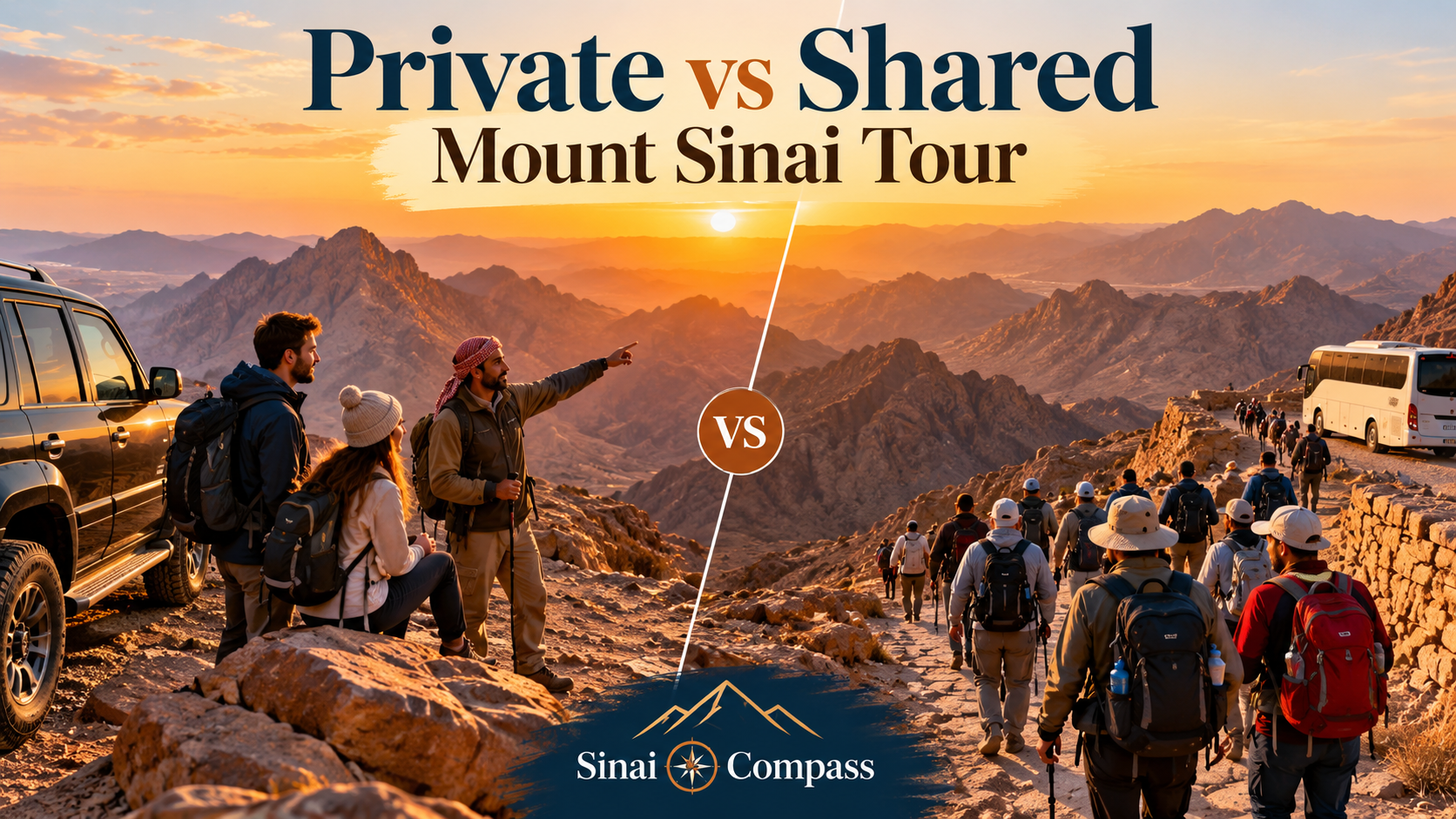
private vs shared Mount Sinai tour
What Is the Difference Between a Private and Shared Mount Sinai Tour?
Quick answer: A private Mount Sinai tour is organized around your own party, while a shared tour combines you with other travelers following a common schedule. The mountain itself remains open to other visitors, so a private tour does not mean a private summit.
The biggest difference is not the mountain you climb. Both private and shared tours can take you to Mount Sinai, also known as Jebel Musa, in the Saint Catherine region of South Sinai. The difference is how the journey is organized before, during, and after the hike.
On a shared excursion, hotel pickups, departure times, rest stops, hiking pace, monastery timing, and the return journey are usually coordinated around the group. This structure keeps the cost per traveler lower, but it also means one person’s delay can affect everyone.
A private tour gives the organizer more room to coordinate around your party. That can matter for couples, families, photographers, older travelers, small groups, or anyone who prefers a less rushed experience.
| Feature | Private Mount Sinai Tour | Shared Mount Sinai Tour |
|---|---|---|
| Transportation | Dedicated to your party | Shared with other travelers |
| Pickup schedule | More adaptable | Usually fixed |
| Hiking pace | Better aligned with your group | Influenced by the wider group |
| Guide interaction | More personal | Attention is divided |
| Rest stops | More flexible | Normally standardized |
| Cost | Higher overall | Lower per person |
| Privacy | Your transport and arrangements are private | You travel with other guests |
| Best suited for | Couples, families, friends, photographers, comfort-focused travelers | Solo travelers, backpackers, and budget-focused visitors |
Why Mount Sinai Is More Than a Standard Sightseeing Excursion
Mount Sinai is both a mountain destination and a place of deep religious and historical significance. UNESCO describes the Saint Catherine Area as sacred to Christianity, Judaism, and Islam and identifies Mount Sinai, Mount Horeb, or Jebel Musa as central to that cultural landscape. Saint Catherine’s Monastery at the foot of the mountain dates to the sixth century and remains one of the world’s oldest continuously functioning Christian monasteries.
This gives the tour a different character from a typical resort excursion. Visitors may come for the sunrise, but the experience also connects mountain scenery, pilgrimage traditions, Bedouin heritage, Byzantine history, and the religious importance of the Saint Catherine region.
For American visitors combining Cairo, Luxor, the Nile Valley, or a Red Sea resort with South Sinai, Mount Sinai can add an active and spiritual dimension to a wider Egypt itinerary.
Is a Private Mount Sinai Sunrise Tour Worth the Extra Cost?
A private Mount Sinai tour is usually worth considering when comfort, control, or personalized pacing matters more than finding the lowest price.
The climb takes place at unusual hours. Sunrise tours generally involve an evening departure, travel into the Saint Catherine mountains, hiking during the night, waiting near the summit for sunrise, descending, and then continuing with the rest of the itinerary.
That schedule can feel long even for active travelers. Having a dedicated vehicle can make the road portion more comfortable because your party is not waiting for multiple hotel pickups or accommodating passengers from several resorts.
Private arrangements are particularly useful when people in the same group have different hiking speeds. You can discuss rest stops, pacing, expectations, and realistic timing with your guide rather than feeling pressure to match a large group.
Sinai Compass describes its private Mount Sinai arrangements as coordinated around factors such as accommodation, group size, hiking ability, and current local conditions. The company also makes an important distinction: private arrangements provide greater control over the journey, but they do not create exclusive access to Mount Sinai itself.
When a Shared Mount Sinai Tour Is the Better Choice
A shared Mount Sinai tour makes sense when price is your main priority and you are comfortable following a predetermined itinerary.
Shared tours can be a practical option for solo travelers who enjoy meeting people or travelers who simply want transportation, guiding, and the main Mount Sinai experience without paying for a dedicated vehicle.
They work particularly well if you are reasonably fit, comfortable hiking at the tour’s expected pace, and do not mind waiting while other passengers are collected or regrouped.
The compromise is flexibility. A shared minibus or coach cannot normally change its entire schedule because one traveler wants longer photography stops, additional rest, or a different departure time.Read also:
Private vs Shared Mount Sinai Tour for the Sunrise Hike
The sunrise itself is one of the most popular reasons to climb Mount Sinai. A typical experience reaches the upper mountain before dawn so visitors can watch the light gradually appear across the surrounding granite ranges.
Official Egyptian tourism information places Mount Sinai at about 2,285 meters and describes two principal approaches: the steeper historic Steps of Repentance and the easier, more gradual Camel Trail. The routes eventually connect before the final climb toward the summit.
Does a private tour mean a quieter Mount Sinai sunrise?
Not necessarily. Sunrise is a popular visiting period, and private tours use the same mountain as other hikers. Paying for a private excursion does not reserve the summit.
What you gain is control over the parts that can actually be controlled: transportation, coordination, your group’s pace, communication with your guide, and sometimes the timing of stops.
Travelers whose priority is avoiding the busiest sunrise period altogether may want to ask about a sunset hike or a broader Saint Catherine mountain itinerary. Sinai Compass notes that sunset and less conventional routes can provide a quieter alternative to the classic sunrise excursion.
Which Mount Sinai Tour Is Better for American Travelers?
For many travelers coming from the United States, a private tour becomes attractive because Mount Sinai is often just one part of a much longer international itinerary.
After a transatlantic flight, Cairo sightseeing, domestic transfers, or several days of travel, an overnight group excursion can be physically demanding. Travelers who value predictable logistics may prefer private transportation so the Mount Sinai experience can fit more naturally into the rest of the trip.
A private format may also be preferable for American families, multigenerational groups, church groups, couples on a customized Egypt itinerary, or travelers who want more time to ask questions about the religious and cultural landscape.
U.S. travelers should also check official travel guidance shortly before departure rather than relying on old information from blogs or forums. At the time this article was prepared, the U.S. Department of State classified Egypt overall as Level 2, “Exercise Increased Caution,” while specifically advising against travel to Northern and Middle Sinai. Saint Catherine and Mount Sinai are in South Sinai. Travel advisories can change, so travelers should review the latest guidance before their trip.
How to Choose Between a Private and Shared Mount Sinai Tour
The easiest way to decide is to look beyond the tour price and consider how you want the entire night and morning to feel.
- Decide how important budget is. If minimizing cost is the priority, a shared tour will usually make more sense.
- Consider your hiking pace. If you walk slowly, want frequent breaks, or travel with different fitness levels, private arrangements offer more breathing room.
- Think about transportation comfort. Long pickup rounds can add fatigue to an already demanding overnight excursion.
- Check what is included. Ask specifically about transfers, local guiding, entrance fees, food, monastery visits, and optional camel assistance.
- Confirm the exact itinerary. Sunrise, monastery access, transportation, and return times should be discussed before booking.
- Ask about current local conditions. Mountain access, weather, road procedures, and site availability can change.
What Should Be Included in a Well-Planned Mount Sinai Tour?
A reliable Mount Sinai itinerary should make the logistics clear before you confirm. You should know where pickup takes place, whether the transfer is private or shared, how guiding is organized, what the expected hiking level is, and what happens after the descent.
Do not assume every “Mount Sinai tour” includes the same services. A low headline price may exclude items that another package includes. Compare the full itinerary rather than comparing only the first number you see.
You should also confirm whether Saint Catherine’s Monastery is expected to be part of the program. Opening arrangements can depend on the day, religious observances, and local conditions, so a responsible operator should avoid promising access that cannot be guaranteed.
What to Wear and Carry for a Mount Sinai Night Hike
Prepare for mountain conditions rather than the temperature at your Red Sea hotel. Saint Catherine sits at a much higher elevation than Sharm El Sheikh, and pre-dawn conditions can feel considerably cooler.
- Comfortable hiking or walking shoes with reliable grip
- Warm layers that can be removed after sunrise
- A lightweight wind-resistant outer layer
- Water for the climb
- Small snacks if they are not provided
- A compact backpack
- Any personal medication you may need
- A charged phone or camera
- Some cash for optional purchases along the route
If you have knee, mobility, heart, respiratory, or other medical concerns, discuss the physical demands with an appropriate medical professional before committing to a mountain hike.
Why Choose Sinai Compass for a Private Mount Sinai Tour?
Sinai Compass is based in El Milgah, Saint Catherine, South Sinai, rather than operating only as an outside booking marketplace. Its published activities include mountain hiking, trekking, transportation, camel journeys, desert safaris, accommodation support, and Saint Catherine experiences.
That local focus is particularly useful in a destination where conditions, access, weather, hiking ability, transportation, and timing all influence the experience.
Instead of choosing a generic package based only on price, travelers can discuss whether they prefer sunrise or sunset, where they are staying, how strong the hikers in the group are, whether Saint Catherine’s Monastery is a priority, and whether Mount Sinai is part of a wider South Sinai journey.
For travelers who want more than the standard summit excursion, Sinai Compass also works with longer Saint Catherine hiking and camping itineraries that explore the wider mountain region rather than treating Jebel Musa as a single photo stop.
Common Mistakes When Booking a Mount Sinai Tour from Sharm El Sheikh
Choosing only by the lowest advertised price
Compare what is actually included. Transportation type, guide arrangements, fees, meals, and extra stops can change the real value of the tour.
Assuming “private” means a private summit
A private tour generally refers to your transport and arrangements. Other visitors may still be hiking or watching sunrise on the mountain.
Ignoring the physical demands of the night hike
Mount Sinai is accessible to many reasonably active travelers, but hiking through the night at altitude and climbing the final steps still requires effort.
Planning a flight immediately after the tour
An overnight hike can leave you tired. When possible, avoid building an extremely tight connection or demanding travel day immediately afterward.
Expecting monastery access without confirmation
Ask what is planned for your exact travel date. Religious sites may follow schedules that differ from ordinary attractions.
Failing to check current travel information
Road procedures, weather, access conditions, and government travel guidance can change. Confirm details close to departure.
Private or Shared Mount Sinai Tour: Which One Should You Book?
Choose a private Mount Sinai tour if you value flexibility, dedicated transport, personalized pacing, easier communication, and a trip designed around your own party. It is particularly suitable for couples, families, small groups, photographers, mature travelers, and visitors making Mount Sinai an important part of a larger Egypt vacation.
Choose a shared Mount Sinai tour if affordability matters most and you are comfortable with fixed pickup times, group pacing, and less control over the itinerary. It can be an efficient choice for solo travelers and budget-conscious visitors.
Neither format changes the history, landscape, or significance of Mount Sinai. The real question is how you want to experience the journey.
For many U.S. travelers making a long trip to Egypt, paying more for a private format can be worthwhile when the goal is not simply to reach the summit, but to experience Saint Catherine with enough comfort, time, and local context to appreciate why the place matters.
Plan Your Mount Sinai Experience with Sinai Compass
If you are deciding between a private sunrise climb, a quieter sunset experience, or a longer Saint Catherine mountain itinerary, Sinai Compass can help you choose an option based on your accommodation, available time, group size, hiking ability, and travel priorities.
Contact Sinai Compass before your trip to discuss the experience you actually want rather than simply booking the first standard excursion you find. A short conversation about your pace and expectations can make the difference between a rushed mountain trip and a well-planned Mount Sinai experience.

Plan Your Mount Sinai Experience with Sinai Compass
Frequently Asked Questions About Private vs Shared Mount Sinai Tours
1. Is a private Mount Sinai tour worth it?
Yes, if you value dedicated transportation, flexible pacing, personalized coordination, and more direct interaction with your guide. Budget travelers may prefer a shared tour.
2. Is a private Mount Sinai tour completely private?
Your transportation and tour arrangements can be private, but Mount Sinai itself is a public pilgrimage and hiking destination, so other visitors may be present.
3. Is a shared Mount Sinai tour cheaper?
Usually, yes. Shared transportation and guiding costs are divided among more travelers, which normally reduces the price per person.
4. How high is Mount Sinai?
Mount Sinai, or Jebel Musa, is approximately 2,285 meters above sea level.
5. How long does the Mount Sinai sunrise hike take?
Egypt’s official tourism information describes the pre-dawn ascent as approximately three to four hours, although actual timing depends on pace and conditions.
6. Can I visit Saint Catherine’s Monastery after the hike?
Many Mount Sinai itineraries plan a monastery visit after the descent, but access and opening arrangements should be confirmed for your specific date.
7. Is Mount Sinai suitable for beginners?
Many reasonably active travelers complete the climb, but the night schedule, altitude, uneven terrain, and final steps can make it physically demanding.
8. Is a private tour better for families?
Often, yes. Families can benefit from dedicated transportation, more flexible rest stops, and a pace adapted to the group.
9. Can I take a camel on Mount Sinai?
Camel assistance may be available on sections of the traditional Camel Trail, but it does not eliminate all walking or the final climb toward the summit.
10. Should U.S. travelers check travel advisories before visiting Mount Sinai?
Yes. American travelers should review the latest U.S. Department of State guidance for Egypt shortly before departure because travel conditions and advisories can change.