Saint Catherine rock climbing guide and logistics
Rock climbing in Saint Catherine offers remote granite walls, long traditional routes, deep cracks, technical multi-pitch objectives, and an extraordinary mountain environment in South Sinai, Egypt. A successful trip, however, requires more than choosing a route. Climbers must arrange local access, transport, an experienced guide, suitable equipment, accommodation, water, weather checks, and a realistic emergency plan.
This Saint Catherine rock climbing guide explains the essential logistics for international climbers. It also shows how sinaicompass can help coordinate the local details that are difficult to arrange from another country, including transfers, guides, accommodation, route planning, and communication before arrival.
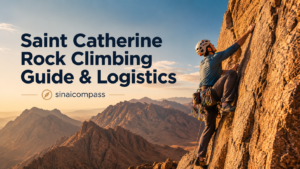
What is rock climbing in Saint Catherine like?
Saint Catherine is primarily a traditional granite climbing destination. The surrounding mountains contain cracks, corners, slabs, chimneys, ridges, and long faces that may require several pitches to complete. Climbers should expect an adventurous mountain environment rather than a heavily developed sport-climbing area.
Published climbing databases describe Saint Catherine as a broad collection of granite peaks and crags where traditional climbing is the dominant style. The wider Sinai climbing database includes hundreds of documented routes, but information for individual lines may be incomplete and local access conditions can change.
Many routes involve longer approaches, route-finding decisions, natural protection, exposed descents, and limited fixed infrastructure. This makes Saint Catherine especially attractive to experienced trad and multi-pitch climbers, but less suitable for someone expecting clearly marked paths, closely spaced bolts, and roadside crags.
Rock climbing is different from hiking Mount Sinai
Technical rock climbing should not be confused with the popular hike to Mount Sinai, also known as Jebel Musa. The Mount Sinai summit hike follows established walking routes and does not normally require ropes or climbing protection. Technical climbing involves helmets, harnesses, ropes, protection systems, belaying, anchor construction, and specialist experience.
The official Egyptian tourism portal identifies Mount Sinai as a 2,285-metre hiking summit with two principal walking routes. It also lists Mount Catherine, at approximately 2,642 metres, as a demanding hiking objective. Neither description represents the full technical climbing experience available on the surrounding granite walls.
Why Saint Catherine appeals to international climbers
Saint Catherine combines technical climbing with a landscape and cultural setting unlike most established climbing destinations. The town stands on a high plateau surrounded by some of Egypt’s highest mountains. Egypt’s State Information Service places Saint Catherine at roughly 1,600 metres above sea level, which explains its cooler climate compared with Egypt’s coastal and lowland destinations.
The wider Saint Catherine Area is also listed as a UNESCO World Heritage Site because of its cultural and religious significance to Christianity, Islam, and Judaism. Climbers therefore enter not only a mountain environment but also a protected cultural landscape connected to Saint Catherine’s Monastery, Mount Sinai, historic trails, Bedouin gardens, and the Jebeleya community.
For visiting climbers, this combination creates several advantages:
- Extensive granite terrain with both established and less-documented lines.
- Long traditional routes that reward crack-climbing and route-finding skills.
- Opportunities to combine climbing with hiking, camping, cultural visits, and desert travel.
- A quieter mountain experience than many crowded European climbing areas.
- Direct interaction with local Bedouin guides who understand the valleys, approaches, weather, and access procedures.
Types of climbing available in Saint Catherine
| Climbing style | What to expect | Recommended experience |
|---|---|---|
| Traditional climbing | Cracks, corners, slabs, natural protection, and route-finding | Competent trad leaders |
| Multi-pitch climbing | Long routes, exposed belays, complex descents, and early starts | Experienced multi-pitch teams |
| Scrambling and mountaineering | Ridges, gullies, rocky summits, and exposed mountain terrain | Fit hikers with mountain experience |
| Bouldering | Granite blocks and short technical problems in selected areas | Intermediate and experienced boulderers |
| Limited sport climbing | Some bolted lines may be available, but conditions and access vary | Climbers able to inspect fixed protection |
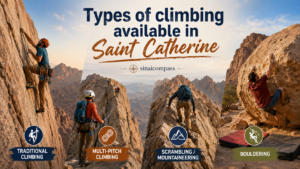
Traditional and multi-pitch climbing
Traditional climbing is the defining activity in Saint Catherine. Leaders place removable protection such as cams and nuts while moving through granite cracks and natural features. Because route descriptions and grading may not be as detailed as they are in major commercial climbing destinations, teams should select objectives conservatively on their first day.
A route that appears moderate on paper may become demanding because of route-finding, sustained crack technique, wind, sun exposure, the length of the descent, or uncertainty about anchors. The first climbing day should therefore be treated as an orientation day rather than an attempt at the largest objective.
Bouldering and shorter climbing days
Bouldering can be incorporated into an itinerary when the group wants a shorter day, needs to recover after a major route, or cannot access a planned wall. Climbers should still use suitable crash pads, spotters, and careful landing assessments. Desert blocks can have uneven landings, loose stones, and sharp granite surfaces.
Do you need a guide or permit to climb in Saint Catherine?
Access requirements can change, and some mountain areas require local guiding and security coordination. Climbers should not assume that arriving with personal equipment guarantees access to every valley, wall, or approach.
The official Egyptian tourism portal advises visitors to confirm that a mountain area is open through a tour operator, hotel, or licensed guide. Climbing references for Saint Catherine also report that guide arrangements and permits can be mandatory in certain locations and that regulations may change.
Before booking international flights, ask the operator to confirm:
- Whether the proposed climbing area is currently accessible.
- Whether a registered local guide is required.
- What identification details must be submitted in advance.
- Whether security approval or checkpoint coordination is necessary.
- Whether camping is allowed at the planned location.
- Who provides the technical climbing guide and who provides local access support.
A local mountain guide and a technical climbing guide may perform different roles. Confirm that the person supervising the climbing has genuine experience with ropes, anchors, protection systems, multi-pitch transitions, and emergency procedures.
Working with the Jebeleya community
The Jebeleya Bedouin community has generations of knowledge about Saint Catherine’s mountain trails, valleys, gardens, water locations, weather patterns, and cultural customs. Local guides can also help visitors navigate unmarked approaches and avoid entering restricted or sensitive areas.
Hiring locally is not simply a logistical formality. It supports the community that has long cared for and travelled through this mountain environment. Climbers should agree clearly on the itinerary, responsibilities, meals, transport, camping arrangements, guide fees, and expected finishing time before departure. see also.
How to reach Saint Catherine
International visitors commonly reach Saint Catherine through Sharm El Sheikh, Dahab, or Cairo. The most practical option depends on flight availability, group size, budget, and current road conditions.
| Starting point | Typical travel method | Planning considerations |
|---|---|---|
| Sharm El Sheikh | Pre-arranged private vehicle or operator transfer | Convenient for international flights and combining climbing with the Red Sea |
| Dahab | Private road transfer | Useful for combining Saint Catherine trad climbing with coastal sport climbing |
| Cairo | Domestic flight to Sharm plus road transfer, or a long overland journey | Allow extra time for traffic, rest stops, and security checkpoints |
A published 2025 journey reported approximately three hours by road from Sharm El Sheikh to Saint Catherine and six to seven hours overland from Cairo. These are planning estimates rather than guaranteed transfer times; roadworks, weather, vehicle checks, and security procedures may extend the journey.
Arriving the evening before the first climbing day is strongly recommended. Travelling overnight and immediately beginning a technical multi-pitch route increases fatigue and leaves little time to inspect equipment, discuss communication systems, or adjust to the cooler mountain climate.
Best time for rock climbing in Saint Catherine
Autumn and spring generally provide the most manageable climbing conditions. October, November, March, and April are common planning windows because they reduce exposure to extreme summer heat while avoiding some of the coldest winter conditions.
Saint Catherine’s elevation means temperatures can differ substantially from Sharm El Sheikh, Dahab, and Cairo. Egyptian climate planning documents note that high-elevation locations such as Mount Catherine can experience sub-zero winter temperatures. Snow, frost, strong wind, and sudden weather changes are possible in the colder months.
Autumn climbing
October and November can offer comfortable daytime temperatures, but exposed walls may still feel hot in direct sun. Climbers should begin early, select the wall according to its orientation, and carry more water than they expect to use.
Winter climbing
December through February can provide crisp conditions on sunny walls, but shaded cracks and high belays may become very cold. Short daylight hours also reduce the margin for route-finding errors or slow descents. Warm layers, gloves for belays, and a reliable headlamp are essential.
Spring climbing
March and April often offer a useful balance between daylight, temperature, and route choice. Nevertheless, wind and cold nights remain possible. Confirm the forecast at town level and for the mountain elevation rather than relying on a coastal forecast.
Summer climbing
Summer is generally less suitable for exposed, all-day routes. Heat increases water requirements, fatigue, and the risk of poor decisions. A summer itinerary, when locally approved, should focus on very early starts, shaded locations, shorter objectives, and strict turnaround times.
Essential climbing equipment
The correct rack depends on the chosen route. Do not rely on a generic packing list without discussing the objective with the guide. Saint Catherine climbing may require a broader traditional rack than a sport-climbing holiday.
Personal equipment
- Properly fitted climbing helmet.
- Harness with enough gear loops for multi-pitch use.
- Climbing shoes suitable for cracks and longer routes.
- Belay and rappel device.
- Locking carabiners and personal anchor system.
- Chalk bag, crack gloves or tape, and lightweight approach shoes.
- Headlamp with spare batteries.
- Sun protection, warm layers, windproof shell, and gloves.
Team equipment
- A route-appropriate single, twin, or half-rope system.
- Cams and nuts in the sizes required by the selected line.
- Slings, quickdraws, alpine draws, and anchor-building material.
- Prusik loops or mechanical ascending equipment for emergencies.
- Rappel backup equipment and spare cord.
- First-aid kit and emergency insulation.
- Offline maps, charged phones, and power banks.
- Water containers and sufficient food for delays.
The UIAA publishes international safety standards covering ropes, helmets, harnesses, and other climbing equipment. Whenever possible, use certified equipment from a reliable source and inspect it before travelling.
Do not assume that ropes, helmets, racks, or crash pads will be available locally. Ask sinaicompass for a written list showing what the operator supplies and what each participant must bring.
Accommodation, food, and water logistics
Choose accommodation in or close to Saint Catherine town so the team can start early without a long morning transfer. Options may include simple hotels, guesthouses, local camps, and mountain camping arrangements. Standards and seasonal availability vary, so confirm heating, bathrooms, electricity, meals, bedding, and check-in time before payment.
Plan meals around the climbing schedule
A long route may begin before normal breakfast service. Ask whether the accommodation can prepare an early packed breakfast and whether the guide provides lunch, hot drinks, and dinner. Carry energy-dense food that remains edible in heat or cold, including nuts, dates, sandwiches, energy bars, and electrolyte products.
Do not depend on natural water sources
Springs and wells are part of the mountain landscape, but their availability and water quality may change. Do not make them the sole source of drinking water unless a knowledgeable local guide has confirmed the plan and suitable treatment is available.
Each climber should begin the day with enough water for the route, approach, descent, and a reasonable delay. Requirements depend on temperature, route length, body size, and sun exposure, so fixed quantities should not replace individual planning.
Safety and emergency planning
Saint Catherine is a remote mountain destination. Emergency medical care, ambulance response, and evacuation may be more limited than in a major city or developed alpine resort. The current United States travel advisory specifically warns that emergency and intensive-care facilities can be limited or unavailable in remote parts of Egypt.
Every team should create an emergency plan covering:
- The exact route and intended descent.
- A turnaround time that accounts for daylight.
- The name and contact details of the guide and driver.
- Who will be informed if the group is overdue.
- The nearest realistic medical facility.
- Emergency communication when mobile coverage fails.
- A retreat plan for injury, weather, route-finding problems, or slow progress.
Clear partner communication is particularly important on long routes where wind or rock features make voice commands difficult. The American Alpine Club identifies poor communication, inadequate belays, short ropes, and anchor problems among recurring causes of climbing accidents. Partners should agree on commands and descent procedures before leaving the ground.
Travel insurance for technical climbing
Standard travel insurance may exclude technical rock climbing, traditional climbing, multi-pitch routes, activities above certain elevations, or climbing without a specifically qualified guide. Obtain written confirmation that the policy covers the exact activity.
Coverage should address emergency treatment, remote rescue, medical evacuation, repatriation, trip interruption, and climbing equipment. Do not rely only on a policy summary; read the exclusions and activity definitions.
Current travel and security considerations
Travel advice for Sinai can differ by nationality and can change at short notice. Some advisories distinguish between South Sinai tourist locations and areas farther north. For example, current UK guidance advises against non-essential travel to parts of northern South Sinai beyond the Saint Catherine–Nuweiba road, while US guidance advises travellers to remain cautious and check current information when visiting Saint Catherine, Mount Sinai, Dahab, and Sharm El Sheikh.
Before departure:
- Read the official advisory issued by your own government.
- Check whether your insurance remains valid for the destination.
- Use a pre-arranged driver familiar with South Sinai procedures.
- Carry your passport and copies of your visa and identification.
- Allow time for checkpoints and document inspections.
- Do not photograph police, military facilities, or security checkpoints.
- Confirm route access again shortly before the climbing day.
How to plan a Saint Catherine climbing trip
- Define the team’s ability. Record each climber’s lead grade, trad experience, multi-pitch experience, crack-climbing ability, and rescue skills.
- Choose realistic objectives. Select several alternatives rather than relying on one route.
- Confirm access. Ask a local operator whether the valleys and walls are currently open.
- Arrange local guides. Confirm both mountain access support and technical climbing competence.
- Prepare documents. Submit passport and nationality details when legitimately required for arrangements.
- Book transport. Use confirmed airport or hotel pickups and allow generous travel time.
- Audit the equipment list. Identify what is supplied locally and what must be brought internationally.
- Purchase suitable insurance. Obtain written confirmation that technical climbing is covered.
- Monitor conditions. Review temperature, wind, precipitation, and daylight before selecting the route.
- Agree on emergency procedures. Establish communication commands, turnaround times, and an overdue plan.
Common mistakes to avoid
Treating Saint Catherine like a developed sport-climbing resort
Many objectives require traditional protection, route-finding, and longer approaches. Arriving with only quickdraws may severely limit the available routes.
Booking flights before confirming access
Mountain access and guiding arrangements can change. Obtain a recent local confirmation before committing to a climbing-only itinerary.
Underestimating the temperature difference
Warm weather in Sharm El Sheikh does not guarantee warm conditions on a high Saint Catherine wall. Pack for wind and cold belays even when the coast is comfortable.
Choosing a major route on the first day
Use the first day to understand local grades, rock texture, protection, approaches, descent systems, and communication with the guide.
Depending entirely on mobile service
Coverage may be weak or absent in remote valleys. Store maps offline, share the itinerary, and agree on a response if the team misses its expected return time.
Failing to inspect fixed protection
Bolts, rappel stations, slings, and anchors should never be assumed safe simply because they already exist. Inspect every component and carry enough equipment to create an alternative when necessary.
Why plan with sinaicompass?
A Saint Catherine climbing trip involves several independent services that must work together: technical guidance, local mountain access, transport, route selection, accommodation, meals, equipment planning, and security coordination. Organising each element separately from abroad can produce gaps or misunderstandings.
sinaicompass can act as a local planning point for the itinerary. The objective is not to promise access to every route, but to provide realistic information, confirm what is currently possible, and match the plan to the team’s experience.
Before confirming a booking, climbers should expect clear answers about:
- The proposed climbing areas and alternative objectives.
- The guide’s technical background and local knowledge.
- Transport arrangements and meeting points.
- Accommodation and meal inclusions.
- Required documents and access procedures.
- Equipment supplied by the operator.
- Cancellation terms when weather or access changes.
- Emergency communication and evacuation planning.
Final planning advice
Saint Catherine rewards climbers who arrive prepared, flexible, and respectful of the local environment. The strongest itinerary is not necessarily the one containing the greatest number of routes. It is the one that allows enough time for transport, rest, access confirmation, equipment checks, acclimatisation to the mountain climate, and alternative plans.
Choose objectives below your maximum ability at the beginning of the trip. Listen to local advice, protect the rock and surrounding landscape, remove all waste, avoid damaging historic or culturally sensitive locations, and support local guides and businesses.
To build a practical itinerary based on your travel dates, climbing grade, group size, preferred route style, and equipment, contact sinaicompass. Early coordination makes it easier to confirm access, arrange reliable transport, select appropriate guides, and prepare for the conditions you are likely to encounter.
Frequently asked questions
Is Saint Catherine suitable for beginner climbers?
It is better suited to experienced climbers. Beginners should participate only under direct supervision on carefully selected routes with suitable equipment.
What type of rock is found in Saint Catherine?
The area is known mainly for granite, with cracks, slabs, corners, chimneys, ridges, and large multi-pitch faces.
Is Saint Catherine mainly a sport-climbing destination?
No. Traditional and multi-pitch climbing are the dominant styles, although some shorter or bolted climbing may be available.
Do I need a local guide?
A local guide or access arrangement may be required for certain areas. Regulations can change, so confirm the requirement before travelling.
What is the best month for climbing?
October, November, March, and April are common choices, but conditions vary. Always check the mountain forecast before selecting a route.
Can I rent climbing equipment in Saint Catherine?
Availability is not guaranteed. Ask for a written equipment inventory and bring essential personal and technical equipment when necessary.
How long should a climbing trip last?
Four to seven climbing days provide time for orientation, rest, weather changes, and different route types. Add separate arrival and departure days.
Can I climb alone in Saint Catherine?
Solo climbing is not recommended because of remote approaches, variable access, limited communication, and the complexity of emergency response.
Should I stay in Dahab or Saint Catherine?
Stay in Saint Catherine for early access to mountain routes. Dahab is useful before or after the trip for coastal activities and additional climbing.
Does normal travel insurance cover rock climbing?
Not always. Confirm in writing that your policy covers technical climbing, multi-pitch routes, medical evacuation, and your planned altitude.