Saint Catherine Christian Sites Private Hiking Tour
A Saint Catherine Christian sites private hiking tour offers something deeper than a standard Mount Sinai excursion. Instead of simply climbing to a viewpoint and returning, you can walk through a landscape shaped by centuries of Christian monastic life, visiting ancient monasteries, small chapels, hermit locations and mountain paths connected with some of Sinai’s most important religious traditions.
For European travellers visiting Egypt, Saint Catherine provides a striking contrast to Cairo, Luxor and the Red Sea coast. With SinaiCompass, the experience can focus on the Christian heritage of the mountains while combining history, walking and the quiet atmosphere that has attracted pilgrims and hermits to South Sinai for centuries.
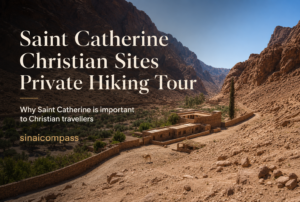
What is a Saint Catherine Christian sites private hiking tour?
A Saint Catherine Christian sites private hiking tour is a guided walking experience built around the religious and historical landscape surrounding Saint Catherine in South Sinai. Depending on the chosen route and current access, a hike may connect monasteries, chapels, ancient monastic areas, mountain gardens and viewpoints associated with Christian traditions.
The important difference is that the journey is not limited to one famous attraction. Saint Catherine’s Monastery may be the best-known landmark, but the surrounding mountains preserve a wider network of Christian heritage that many visitors never see.
A private Christian heritage hike in Saint Catherine combines pilgrimage history with mountain walking, allowing travellers to understand how early monastic communities lived within the valleys and highlands of Sinai.
Why Saint Catherine is important to Christian travellers
Saint Catherine is one of Egypt’s most significant religious landscapes. The Saint Catherine Area is recognised as a UNESCO World Heritage Site, while the monastery at the foot of Mount Sinai has remained a centre of Christian monastic tradition for many centuries.
The monastery was constructed during the reign of Byzantine Emperor Justinian I in the sixth century. Its location is traditionally associated with the biblical story of Moses and the Burning Bush, while Mount Sinai itself has long been linked with the receiving of the Ten Commandments.
Yet the significance of the area extends beyond the main monastery. Hermits and monks established places of prayer throughout the valleys and mountains. Some of these locations remain visible today as small chapels, monasteries, caves and cultivated mountain gardens.
This makes Saint Catherine especially interesting for visitors who want to understand Christian history through the landscape rather than viewing religious heritage only inside museums or large monuments.
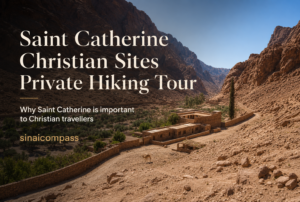
Christian sites you may explore around Saint Catherine
The exact locations included in a private hike should depend on the selected route, walking ability, current accessibility and local conditions. However, the wider Saint Catherine area contains several important Christian heritage locations that can form part of a carefully planned itinerary.
Saint Catherine’s Monastery
Saint Catherine’s Monastery stands beneath Mount Sinai and forms the historical centre of the region’s Christian heritage. Built in the Byzantine period, it is among the world’s oldest monasteries still serving its original monastic purpose.
Within the monastery complex are locations traditionally connected with biblical and Christian history, including the Chapel of the Burning Bush and the Well of Moses. The monastery also preserves remarkable religious architecture and collections accumulated through centuries of monastic life.
Because visiting conditions and opening arrangements can vary, travellers should confirm current access when planning their itinerary rather than assuming every part of the complex will be open.
Mount Sinai and its Christian pilgrimage tradition
Mount Sinai, also called Jebel Musa, is the most famous mountain associated with Saint Catherine. For Christian pilgrims, its significance comes from the biblical tradition identifying the mountain with Moses receiving the Law.
Two principal approaches have historically been associated with the ascent: the more gradual mountain trail and the much steeper Steps of Repentance. Both ultimately lead toward the summit area.
A Christian-focused private hike does not have to become a rushed sunrise climb. Travellers interested in religious history may prefer to walk more slowly, allowing time to understand the chapels and traditions found along and around the sacred mountain.
The Chapel of Elijah
Below the summit of Mount Sinai is a natural basin associated with the Prophet Elijah. The monastery’s historical description records chapels dedicated to Elijah and Elisha in this area.
For visitors interested in biblical geography, this stop helps show how different scriptural traditions became connected with particular locations throughout the Sinai mountains.
Monastery of the Forty Martyrs
Located in a valley southwest of Mount Sinai, the Monastery of the Forty Martyrs, or Deir al-Arbaeen, represents another layer of the region’s monastic landscape.
Its relatively secluded setting illustrates an important aspect of early Christian life in Sinai: religious communities did not exist only inside the fortified monastery. Prayer, farming and retreat also took place in quieter valleys surrounded by mountains.
Saint John Climacus heritage in Wadi Itlah
Wadi Itlah is associated with Saint John Climacus, also known as John of the Ladder, one of the best-known figures of Sinai’s Christian monastic tradition.
He lived as a hermit before later becoming abbot of the Sinai monastery and is traditionally associated with a cave and chapel in the valley. Visiting such an area gives hikers a clearer sense of why solitude and the mountain environment became central to early monastic practice.
Monastery of Saints Kosmas and Damianos
In the Wadi Tala area is a small monastery dedicated to Saints Kosmas and Damianos. Its secluded valley setting and surrounding cultivated land demonstrate the close relationship between monastic communities and traditional mountain agriculture. see also.
A hike through this part of Saint Catherine can therefore combine Christian heritage with granite scenery and the garden landscapes characteristic of the high mountain region.
Mount Catherine and the Chapel of Saint Catherine
Mount Catherine, or Jebel Katrina, is another major destination for experienced hikers. A chapel on the summit commemorates the tradition connecting the mountain with Saint Catherine of Alexandria.
This is a more demanding mountain objective than a gentle valley walk, so it should be selected according to fitness, weather, available time and local guidance rather than treated as an automatic part of every itinerary.
Private Christian hiking tour vs standard Mount Sinai excursion
| Experience | Standard Mount Sinai Excursion | Private Christian Sites Hike |
|---|---|---|
| Main focus | Reaching Mount Sinai | Christian heritage and mountain landscape |
| Pace | Usually structured around a fixed objective | Can be adapted to the chosen route |
| Sites | Main mountain and monastery area | Potentially monasteries, chapels, valleys and hermit locations |
| Historical depth | General introduction | More time for religious and local context |
| Walking level | Typically centred on the Mount Sinai ascent | Can range from valley walks to demanding mountain hikes |
| Best for | Visitors wanting the classic Mount Sinai experience | Travellers interested in Christianity, pilgrimage and hiking |
Why a private hiking format works well in Saint Catherine
A private format is particularly useful in Saint Catherine because travellers do not all arrive with the same interests or fitness level.
Some visitors want a physically challenging mountain day. Others want to photograph chapels, learn about Christian monastic history or walk through quiet valleys without attempting a major summit.
A private itinerary makes it easier to build the experience around:
- Your walking ability and previous hiking experience.
- Your interest in biblical and Christian history.
- The amount of time available in Saint Catherine.
- Weather and mountain conditions.
- Photography and sightseeing priorities.
- The accessibility of particular religious locations.
This flexibility is particularly valuable for travellers coming from Europe who may be fitting Saint Catherine into a wider Egypt journey involving Cairo, Luxor, Dahab or Sharm El Sheikh.
A landscape of pilgrimage rather than a single monument
One of the most rewarding ways to understand Saint Catherine is to stop thinking of it as one monastery beside one famous mountain.
The region is better understood as a connected sacred landscape. Monasteries stand near gardens. Chapels appear in mountain basins. Hermit traditions are associated with caves and isolated valleys. Ancient paths connect communities with places of prayer.
Walking creates a different relationship with this history. Distances, elevation and silence become part of the explanation. A remote chapel feels different when you have approached it through the same granite landscape that shaped generations of monastic life.
How difficult is a Christian sites hiking tour?
It does not have to be a difficult mountain expedition. The hiking level depends on the route you choose.
Lower valleys around Saint Catherine can provide relatively accessible walking for visitors who are comfortable on uneven natural terrain, while Mount Sinai, Mount Catherine and more exposed mountain routes require greater stamina and preparation.
Before choosing a route, consider:
- How many hours you are comfortable walking.
- Whether you regularly hike on rocky terrain.
- How you handle sustained uphill walking.
- Whether you prefer valleys or mountain summits.
- Seasonal temperature and weather conditions.
Do not choose a route purely because a summit is famous. A lower-level heritage walk can sometimes provide more time for Christian sites, photography and conversation.
What to bring for hiking in Saint Catherine
Saint Catherine is a genuine mountain environment. Visitors should prepare for rocky ground and changing temperatures rather than dressing as they would for a normal resort excursion.
- Comfortable hiking shoes with reliable grip.
- Water appropriate to the length and conditions of the walk.
- Sun protection, including a hat and sunscreen.
- Layered clothing for temperature changes.
- A light backpack.
- Personal medication when required.
- A phone or camera if photography is important to you.
- Respectful clothing when entering religious locations.
In cooler periods, mountain temperatures can feel considerably colder than Egypt’s coastal resorts, particularly early in the morning, after sunset or at elevation.
Respecting monasteries, chapels and sacred places
Christian heritage sites in Saint Catherine should be treated as living or sacred places rather than simply photographic attractions.
Visitors should follow local instructions, dress appropriately, avoid disturbing worship or private monastic areas and ask before photographing people or sensitive religious spaces.
Access to small monasteries, chapels and other heritage locations should never be assumed. A place visible on a map or described historically may not necessarily be accessible to visitors on a particular day.
Why European travellers add Saint Catherine to an Egypt itinerary
Many visitors from Europe first associate Egypt with pharaonic monuments, Nile cruises or Red Sea beaches. Saint Catherine introduces a completely different cultural landscape.
It can be especially meaningful for travellers interested in early Christianity, Byzantine history, Orthodox traditions, pilgrimage routes, biblical geography or mountain trekking.
The region also fits naturally into a South Sinai journey. Visitors staying in Dahab or Sharm El Sheikh can consider travelling inland to Saint Catherine, although transport, hiking time and overnight arrangements should be planned in advance.
Rather than attempting to fit too much into one rushed excursion, travellers with a strong interest in Christian heritage may benefit from allowing enough time to explore beyond the most famous Mount Sinai route.
Why choose SinaiCompass for a Christian sites hiking experience?
SinaiCompass focuses on travel and outdoor experiences across Sinai and specifically presents Christian heritage sites alongside hiking and trekking in the Saint Catherine region.
For a private Christian sites itinerary, the main advantage is the ability to discuss the experience according to your actual interests. You may want to concentrate on Mount Sinai, explore lower valleys connected with monastic heritage or combine religious sites with a broader mountain hike.
Instead of choosing a route only from its name, share your hiking experience, available time and the places that interest you. A realistic route can then be considered according to current conditions and access.
How to plan your Saint Catherine Christian hiking tour
A good private hiking experience begins before you arrive at the trail.
- Decide your main interest. Choose whether Christian heritage, hiking, pilgrimage, photography or a combination is your priority.
- Assess your fitness realistically. Distinguish between an easy valley walk and a major mountain ascent.
- Choose your starting point. Tell the organiser whether you will already be in Saint Catherine or travelling from another part of South Sinai.
- Identify important sites. If a particular monastery, chapel or biblical location matters to you, mention it during planning.
- Confirm current access. Religious sites and mountain routes can be affected by local arrangements and conditions.
- Prepare suitable equipment. Footwear and clothing should match the selected route rather than the weather at your beach resort.
Common mistakes to avoid
Assuming every Christian site can be visited in one day
The Saint Catherine heritage landscape is spread across different valleys and mountains. Trying to include too many locations can turn a meaningful walk into a rushed checklist.
Choosing the hardest hike because it sounds more impressive
A demanding summit is not automatically the most rewarding option. Match the route to your actual ability and interests.
Ignoring temperature differences
Conditions in the mountains can be very different from those on the Red Sea coast. Bring layers and prepare according to the season and elevation.
Treating sacred sites only as tourist attractions
Some places remain connected with active religious traditions. Respect restrictions, privacy and local guidance.
Planning around outdated opening information
Always confirm current monastery access, local procedures and route conditions close to the date of your visit.
Is a Saint Catherine Christian sites private hiking tour worth it?
Yes, particularly for travellers who want to combine Christian history with a genuine mountain experience.
The value of Saint Catherine lies in the relationship between faith, history and landscape. The monastery is extraordinary, but walking into the surrounding valleys reveals why monks, hermits and pilgrims were drawn to Sinai in the first place.
A carefully chosen route can move from major biblical associations to small chapels and secluded monastic landscapes while also giving visitors time to experience the granite mountains of South Sinai.
For travellers interested in Christianity, history or pilgrimage, this deeper approach can make Saint Catherine one of the most distinctive parts of an Egypt journey.
Plan your private Christian heritage hike with SinaiCompass
If you want to explore Saint Catherine beyond the standard sightseeing route, contact SinaiCompass with your travel dates, where you will be staying, your walking level and the Christian sites that interest you most.
From a gentler heritage walk through the valleys to a more ambitious mountain itinerary, the next logical step is to choose a route that matches both your interests and realistic hiking ability. SinaiCompass can help you consider a private Saint Catherine experience based on current access and local conditions.
Frequently Asked Questions
1. What is a Saint Catherine Christian sites private hiking tour?
It is a privately guided walking experience combining the mountains of Saint Catherine with monasteries, chapels and locations associated with Christian and biblical traditions.
2. What is the most important Christian site in Saint Catherine?
Saint Catherine’s Monastery is the region’s most famous Christian landmark and forms part of the UNESCO-listed Saint Catherine Area.
3. Can I visit Mount Sinai during a Christian heritage tour?
Yes. Mount Sinai can form part of the itinerary when the selected route, available time and hiking ability make it appropriate.
4. Are there Christian sites outside Saint Catherine’s Monastery?
Yes. The surrounding mountains contain chapels, smaller monasteries and locations associated with historic hermit and monastic traditions.
5. Is the tour suitable for beginners?
It can be. Easier valley routes may suit beginners comfortable on uneven terrain, while summit routes require greater fitness.
6. Do I need hiking boots?
Sturdy footwear with good grip is strongly recommended because Saint Catherine trails generally involve natural, rocky and uneven terrain.
7. Can I take a Saint Catherine tour from Dahab or Sharm El Sheikh?
Saint Catherine can be incorporated into a wider South Sinai itinerary from either area, but transport and timing should be arranged in advance.
8. Can every monastery and chapel be entered?
No. Access may depend on current local arrangements, religious activity and site-specific restrictions, so availability should be confirmed before the hike.
9. Is a private Christian hiking tour only for religious pilgrims?
No. It can also appeal to hikers, photographers and travellers interested in history, Byzantine heritage, biblical geography and mountain culture.
10. How do I choose the right route?
Choose according to your fitness, available time, preferred Christian sites and whether you want a valley walk, Mount Sinai experience or more demanding mountain hike.